Academy · Course 12 Regulatory requirementLabel dataCalculators
Most of a capsule or tablet is not the botanical, and every other ingredient needs a legal basis, a place on the label and a job
What fillers, binders, flow agents, lubricants, coatings, shells and carriers do; how U.S. rules list, limit and label them; and how they change flow, impurities and allergens. Label data and two calculators make it concrete.
In ICH's worked example of an oral tablet, 2.3 of the 2.5 grams are excipients
92%of the example tablet's mass is excipient (ICH Q3D(R2), Table A.4.1)
4other ingredients on the median sampled U.S. supplement label (n = 600)
31%of sampled labels list silicon dioxide or silica
2%most silicon dioxide allowed, by weight of the food (21 CFR 172.480)
Where the mass of ICH's example tablet comes from (mg per day)ICH illustrative example
ICH Q3D(R2) Guideline (2022), Appendix 4, Table A.4.1: a solid oral drug product of 2.5 g per day with one drug substance and eight excipients. A worked example in the guideline, not a supplement formula.Data table: the nine components
ICH Q3D(R2) Table A.4.1, maximum daily intake of each component
Component
g per day
Share of 2.5 g
Drug substance
0.200
8.0%
Microcrystalline cellulose
1.100
44.0%
Lactose
0.450
18.0%
Calcium phosphate
0.350
14.0%
Crospovidone
0.265
10.6%
Magnesium stearate
0.035
1.4%
Hydroxypropylmethyl cellulose (HPMC)
0.060
2.4%
Titanium dioxide
0.025
1.0%
Iron oxide
0.015
0.6%
Drug product
2.500
100%
You will learn
What each class of other ingredient does in a tablet, capsule or dried extract.
How 21 CFR 101.4 orders, heads and groups the ingredient statement.
Which legal route an excipient needs, and the limits its listing sets.
How flow agents and lubricants change powder flow and tablets.
Why “inert” means something else in EPA pesticide law.
Status. EUTECNIQ has no laboratory or products. Label statistics come from a sample of a public NIH database; calculators are educational, not legal advice.
1 · Eight jobs in one unit
Each other ingredient does one physical job, and the food regulations name several of those jobs outright
Where fillers, binders, disintegrants, flow agents, lubricants, coatings and shells sitSchematic; roles from 21 CFR
Not to scale. Roles as named in 21 CFR 172.480, 172.868, 172.870, 172.874, 182.1217, 184.1440, 73.200 and 73.575 (eCFR, up to date as of October 22, 2026).
Lubricants are usually 0.25–5% of a tablet (Li and Wu 2014) and silicon dioxide is capped at 2%; fillers and shells make up the bulk.
Explanation, details and sources
A botanical extract is rarely dosed alone. Fillers bring a small dose up to a mass a machine can fill or press; binders hold compressed particles together; disintegrants break the tablet apart once it is wet; flow agents (glidants) keep powder moving through hoppers, which the Scale-up and tech transfer page grades with a USP <1174> flow classifier; lubricants stop it sticking to steel; coatings and shells protect, mask and identify the unit.
FDA's list of functional effects in 21 CFR 170.3(o) names several of these jobs. Paragraph (o)(14), “Formulation aids”, covers “carriers, binders, fillers, plasticizers, film-formers, and tableting aids”; (o)(1) covers “Anticaking agents and free-flow agents”; (o)(18) covers “Lubricants and release agents: Substances added to food contact surfaces to prevent ingredients and finished products from sticking to them.” The list has no separate term for a disintegrant.
Li and Wu (2014) report that “magnesium stearate and stearic acid are the most frequently used lubricants in the pharmaceutical industry”, used at “usually 0.25%–5.0%, w/w”. Desai, Liew and Heng (2016) describe the disintegrant as “responsible for ensuring the break-up of the tablet matrix upon ingestion”.
On 600 randomly sampled U.S. labels, silicon dioxide and magnesium stearate lead, and each dosage form has its own set
Share of sampled labels listing each class under other ingredientsNIH label data, sampled
Random sample of 600 on-market labels from the NIH Office of Dietary Supplements Dietary Supplement Label Database (API v9.5.0, data of September 25, 2025), retrieved October 24, 2026. Classes assigned by name; method below.Data table: labels per class
Labels listing each class under other ingredients (n = 600)
Class
Role
Labels
Share
95% interval
Silicon dioxide or silica
Anticaking and free-flow agent
186
31.0%
27.4–34.8%
Magnesium stearate
Lubricant and release agent
151
25.2%
21.9–28.8%
Gelatin
Capsule or softgel shell
123
20.5%
17.5–23.9%
Glycerin
Plasticizer or liquid base
116
19.3%
16.4–22.7%
Cellulose (unspecified or vegetable)
Filler or capsule material
110
18.3%
15.4–21.6%
Hypromellose (HPMC)
Capsule shell or film former
87
14.5%
11.9–17.5%
Microcrystalline cellulose
Filler and binder
80
13.3%
10.8–16.3%
Stearic acid
Lubricant
67
11.2%
8.9–13.9%
Rice flour, hull or concentrate
Filler
64
10.7%
8.4–13.4%
Maltodextrin
Carrier or filler
45
7.5%
5.7–9.9%
Lecithin
Emulsifier
42
7.0%
5.2–9.3%
Calcium phosphates
Filler
41
6.8%
5.1–9.1%
Croscarmellose sodium
Disintegrant
32
5.3%
3.8–7.4%
Titanium dioxide
Color additive (opacifier)
28
4.7%
3.2–6.7%
Certified colors (FD&C)
Color additive
27
4.5%
3.1–6.5%
Gum arabic (acacia)
Emulsifier, stabilizer
18
3.0%
1.9–4.7%
Pharmaceutical glaze or shellac
Coating
12
2.0%
1.1–3.5%
Talc
Glidant or anticaking
8
1.3%
0.7–2.6%
Each dosage form has its own excipient fingerprint (% of labels of that form)NIH label data, sampled
Same sample. Select a column heading to sort the rows. Forms as coded in DSLD; “Other forms” pools gummies, lozenges and other forms (n = 31). On phones: Caps capsule, Tabs tablet or pill, Soft softgel, Powd powder, Liq liquid, Oth other forms.Data table: class by dosage form
Share of labels of each dosage form that list each class (%)
Class
Capsule (n = 209)
Tablet or pill (n = 87)
Softgel (n = 49)
Powder (n = 120)
Liquid (n = 104)
Other forms (n = 31)
Silicon dioxide or silica
43.1
70.1
10.2
20.8
0.0
16.1
Magnesium stearate
41.6
64.4
0.0
0.0
0.0
25.8
Gelatin
31.6
8.0
93.9
0.0
0.0
12.9
Glycerin
4.8
8.0
95.9
0.8
47.1
6.5
Cellulose (unspecified or vegetable)
32.5
44.8
0.0
0.8
0.0
6.5
Hypromellose (HPMC)
33.5
16.1
0.0
0.8
0.0
6.5
Microcrystalline cellulose
23.4
31.0
0.0
1.7
0.0
6.5
Stearic acid
4.8
59.8
2.0
0.8
0.0
9.7
Rice flour, hull or concentrate
26.8
3.4
0.0
3.3
0.0
3.2
Maltodextrin
7.7
11.5
4.1
11.7
1.0
6.5
Lecithin
1.4
3.4
24.5
17.5
1.0
6.5
Calcium phosphates
5.3
28.7
0.0
3.3
0.0
3.2
Croscarmellose sodium
1.0
32.2
0.0
0.0
0.0
6.5
Titanium dioxide
5.7
10.3
8.2
0.0
0.0
9.7
Certified colors (FD&C)
1.9
8.0
0.0
12.5
1.0
0.0
Gum arabic (acacia)
2.4
6.9
0.0
4.2
1.0
3.2
Pharmaceutical glaze or shellac
1.0
8.0
2.0
0.0
0.0
6.5
Talc
1.4
4.6
0.0
0.0
0.0
3.2
Excipients travel together: classes listed on the same labelNIH label data, sampled
Same sample. Node size: number of labels listing the class; line width: labels listing both. MCC: microcrystalline cellulose; HPMC: hypromellose; TiO2: titanium dioxide. Pairs found on fewer than 15 labels are not drawn.Data table: pairs listed together
Pairs of classes listed on the same label (36 pairs with 15 or more labels)
Class
Listed with
Labels
Magnesium stearate
Silicon dioxide or silica
107
Cellulose (unspecified or vegetable)
Silicon dioxide or silica
69
Cellulose (unspecified or vegetable)
Magnesium stearate
61
Microcrystalline cellulose
Silicon dioxide or silica
59
Silicon dioxide or silica
Stearic acid
55
Hypromellose (HPMC)
Silicon dioxide or silica
47
Magnesium stearate
Stearic acid
47
Microcrystalline cellulose
Magnesium stearate
46
Gelatin
Glycerin
46
Hypromellose (HPMC)
Magnesium stearate
44
Gelatin
Magnesium stearate
39
Gelatin
Silicon dioxide or silica
39
Cellulose (unspecified or vegetable)
Stearic acid
34
Calcium phosphates
Silicon dioxide or silica
33
Rice flour, hull or concentrate
Silicon dioxide or silica
31
Hypromellose (HPMC)
Microcrystalline cellulose
30
Calcium phosphates
Magnesium stearate
27
Croscarmellose sodium
Silicon dioxide or silica
26
Maltodextrin
Silicon dioxide or silica
26
Microcrystalline cellulose
Stearic acid
25
Hypromellose (HPMC)
Rice flour, hull or concentrate
24
Croscarmellose sodium
Magnesium stearate
24
Croscarmellose sodium
Stearic acid
23
Calcium phosphates
Stearic acid
23
Magnesium stearate
Rice flour, hull or concentrate
21
Cellulose (unspecified or vegetable)
Rice flour, hull or concentrate
20
Croscarmellose sodium
Microcrystalline cellulose
19
Magnesium stearate
Titanium dioxide
19
Maltodextrin
Magnesium stearate
18
Cellulose (unspecified or vegetable)
Microcrystalline cellulose
18
Calcium phosphates
Cellulose (unspecified or vegetable)
18
Certified colors (FD&C)
Silicon dioxide or silica
17
Glycerin
Lecithin
16
Gelatin
Microcrystalline cellulose
15
Calcium phosphates
Microcrystalline cellulose
15
Silicon dioxide or silica
Titanium dioxide
15
Softgel labels list gelatin (94%) and glycerin (96%); tablet labels list silica (70%), magnesium stearate (64%) and stearic acid (60%).
Explanation, details and sources
Sampling. DSLD held 214,780 labels on October 24, 2026, of which 121,959 were marked on market. Label identifiers were drawn at random without replacement from 1 to 330,000 (seed 20261024); an identifier with no label, or with a label marked off market, was skipped; the first 600 on-market labels were kept after 1,800 draws. The range excludes about 850 on-market labels (0.7%) added in the latest update, whose identifiers run to 340,294.
Classes. An entry counts toward a class when its name, or a listed form, matches a fixed name pattern (for example “silicon dioxide” or “silica”, but not “silicate”). A label counts once per class. A match shows that the label lists the substance, not why it was added. Entries DSLD stores as ingredients but which are headings (“Contains 2% or less of”, “None”) are not counted; 16 labels (2.7%; 95% interval 1.6–4.3%) used such a 2% heading, and 67 listed no other ingredient.
Limits. DSLD transcribes labels as printed, so spelling varies and some entries are bundled. Intervals are Wilson 95% intervals for a simple random sample. The script, the label records and the aggregates are published with the site code (src/modules/acexc/compute/).
Source: NIH Office of Dietary Supplements, Dietary Supplement Label Database, https://dsld.od.nih.gov, API https://api.ods.od.nih.gov/dsld/v9/ (version 9.5.0, May 2026; index of September 25, 2025), retrieved October 24, 2026.
3 · How they are labeled
Excipients are listed below the Supplement Facts panel by weight, under “Other ingredients” when the panel names a source
Five labeling rules on one illustrative label21 CFR 101.4 and 101.36; FALCPA
Illustrative label, not a product. 21 CFR 101.4(a), (g) and (h) and 101.36(d) (eCFR, October 22, 2026); FDA, “Food Allergies: What You Need to Know” (content current as of March 11, 2026).
Componentmg per unitIn panel
Unit mass
Listed below the panel
Silicon dioxide (limit 2%)
Titanium dioxide (limit 1%)
Iron from iron oxide (limit 5 mg/day)
Allergen keywords found
The ingredient statement this formula producesEducational tool
Rules: 21 CFR 101.4(a)(1), (a)(2) and (g); 101.36(d); 172.480(b)(4); 172.410(b); 73.575(c)(1); 73.200(c)(1)(iii). Allergens: FD&C Act 201(qq), as amended by the FASTER Act (2021).
Method, assumptions and limits
What it calculates
The ingredient statement for one unit: heading, order and the optional quantifying group; each component's share of the unit mass; the silicon dioxide, calcium silicate and titanium dioxide shares against their listed limits; elemental iron per day from iron oxide; allergen keywords.
Equations
sharei = 100 × mi / Σm. Rows not ticked “In panel” are sorted by m, largest first. With a threshold t, rows with share ≤ t follow “Contains t% or less of:”. Iron per day = m(iron oxide) × 0.69943 × units per day, where 0.69943 = 2 × 55.845 / 159.687, the iron fraction of Fe2O3.
Variables and units
Masses in mg per unit (capsule shell included, because the limits are set “by weight of the food”); shares in %; iron in mg per day.
Assumptions
A ticked row is a dietary ingredient or a source named in the Supplement Facts panel (101.36(d)), so it is not repeated and the heading becomes “Other ingredients” (101.4(g)). Iron oxide is taken as Fe2O3; other iron oxides contain a different share of iron. Limits are recognized by name only.
Valid range
0–5,000 mg per row; 1–12 units per day. Rows with no name or no mass are ignored.
What it does not establish
That a formula, a name or a label is lawful. It does not check common or usual names, Herbs of Commerce names, plant parts, sub-ingredients, color declarations, claims, serving size or net quantity, and the allergen screen is a keyword search, not a review.
References
21 CFR 101.4, 101.36, 172.410, 172.480, 73.200, 73.575 (eCFR, October 22, 2026); FDA, Dietary Supplement Labeling Guide, Chapter IV (April 2005); IUPAC standard atomic weights.
Verification
Unit tests (tests/unit/acexc.test.js) and an independent Python reference (tests/numerics/ref/academy_other-ingredients.py) recompute every readout.
“Other dietary ingredients” in the panel and “Other ingredients” below it are different legal categories.
21 CFR 101.4(g) reads: “When present, the ingredient list on dietary supplement products shall be located immediately below the nutrition label, or, if there is insufficient space below the nutrition label, immediately contiguous and to the right of the nutrition label and shall be preceded by the word ‘Ingredients,’ unless some ingredients (i.e., sources) are identified within the nutrition label in accordance with § 101.36(d), in which case the ingredients listed outside the nutrition label shall be in a list preceded by the words ‘Other ingredients.’ Ingredients in dietary supplements that are not dietary ingredients or that do not contain dietary ingredients, such as excipients, fillers, artificial colors, artificial sweeteners, flavors, or binders, shall be included in the ingredient list.”
Order. 101.4(a)(1) requires listing “in descending order of predominance by weight”, and lets dietary ingredients already in the panel go unrepeated. Under 101.4(a)(2), ingredients at 2 percent or less may instead follow “Contains __ percent or less of”, with a threshold of 2, 1.5, 1.0 or 0.5 percent, and “No ingredient to which the quantifying phrase applies may be present in an amount greater than the stated threshold.”
The rule cited for this in some summaries, 101.36(g), concerns where nutrition information sits on the label (by reference to 101.2); the ingredient-list rule is 101.4(g), with 101.36(d) for sources.
FDA's guide. In its Dietary Supplement Labeling Guide (April 2005), FDA answers that a magnesium salt used as a binder belongs in the ingredient statement below the panel, not in the panel (Chapter IV, Nutrient Declaration, Question 5).
Sources: eCFR, 21 CFR 101.4 and 101.36 (up to date as of October 22, 2026); FDA, Dietary Supplement Labeling Guide, Chapter IV.
4 · Legal status
An excipient needs its own legal route, because the supplement exemption from food-additive rules covers dietary ingredients only
The questions that decide whether a non-dietary ingredient may be usedFDA guidance and statute
FDA, Guidance for Industry: Considerations Regarding Substances Added to Foods, Including Beverages and Dietary Supplements (January 2014; docket FDA-2009-D-0542), section III.B and footnote 2; FD&C Act 201(s) and 402(a)(2)(C); 21 CFR 170.30.
Fifteen common excipients: listing, legal basis, the condition it names and pharmacopeial harmonization21 CFR; PDG status
eCFR Title 21 (up to date as of October 22, 2026); “None found”: no section matched an eCFR full-text search on October 24, 2026. PDG: EDQM, Harmonisation status for excipient monographs (as of September 1, 2026). One-line summaries of 21 CFR Parts 172, 182 and 184: CFR atlas.
Microcrystalline cellulose and croscarmellose sodium are not named anywhere in 21 CFR, so their lawful use rests on a route outside the listings, such as GRAS.
Explanation, details and sources
FDA's position, quoted. “Section 201(s) of the FD&C Act (21 U.S.C. § 321(s)) exempts dietary ingredients used in dietary supplements from the food additive definition. … However, other ingredients intended for use in dietary supplements, such as binders, excipients, and fillers, are not exempt from the food additive definition and must meet the same requirements as substances added to conventional foods. In other words, non-dietary ingredients added to a dietary supplement must be used in accordance with a food additive regulation or be GRAS for their intended use (unless they qualify for another exception to the food additive definition).”
Titanium dioxide. 21 CFR 73.575 lists it as a color additive exempt from certification, at no more than 1 percent by weight of the food. A 2023 petition asks FDA to revoke that listing (88 FR 27818, May 3, 2023); no final action was found in the Federal Register as of October 24, 2026. In the EU, Commission Regulation (EU) 2022/63 ended its authorization as a food additive from August 7, 2022, after EFSA concluded in May 2021 that it “can no longer be considered safe when used as a food additive” (as reported by the Food Safety Authority of Ireland).
Where these parts sit. The CFR atlas summarizes every part cited here, from 21 CFR 101 to 40 CFR 180, in one line each.
GRAS reform. A proposed rule of August 11, 2026 would make GRAS notification mandatory for human food substances (91 FR 51834); comments close December 9, 2026. As of October 2026, independent GRAS conclusions remain lawful.
Supplier qualification. For components that are not dietary ingredients, 21 CFR 111.75(a)(2) requires the manufacturer to confirm identity and specifications by its own tests, or to rely on a supplier's certificate of analysis after qualifying that supplier.
Pharmacopeial monographs. The Pharmacopoeial Discussion Group (USP, Ph. Eur., JP) harmonizes excipient monographs; EDQM's table of September 1, 2026 lists 69. Colloidal silicon dioxide is still in elaboration; maltodextrin, acacia and titanium dioxide are not on the list. 21 CFR 101.36(d)(3) allows a label to state that a source “conforms to an official compendium”, for example “calcium carbonate USP”.
Sources: FDA guidance (January 2014), https://www.fda.gov/media/87680/download; 21 CFR 73.575, 111.75, 101.36 (eCFR); Federal Register 88 FR 27818 and 91 FR 51834; FSAI news, July 15, 2022; EDQM PDG status table.
5 · Carriers in dried extracts
A carrier dilutes the native extract, so an extract ratio means little until you know what was counted
Genuine extract per unit
Carrier and other excipients
Herbal substance equivalent, low
Herbal substance equivalent, high
Herb per unit of finished extract, low end
Marker per unit; in the genuine extract
Final concentration, solvent per g
Starting material per serving
What one unit contains, and what it corresponds toEducational tool
EMA/HMPC/CHMP/CVMP/287539/2005 Rev.1 (March 11, 2010), definitions and sections 6.2.1 and 6.2.3; 21 CFR 101.36(b)(3)(ii)(B)–(C). Why carriers make drying possible: the glass-transition explorer on Scale-up and tech transfer.
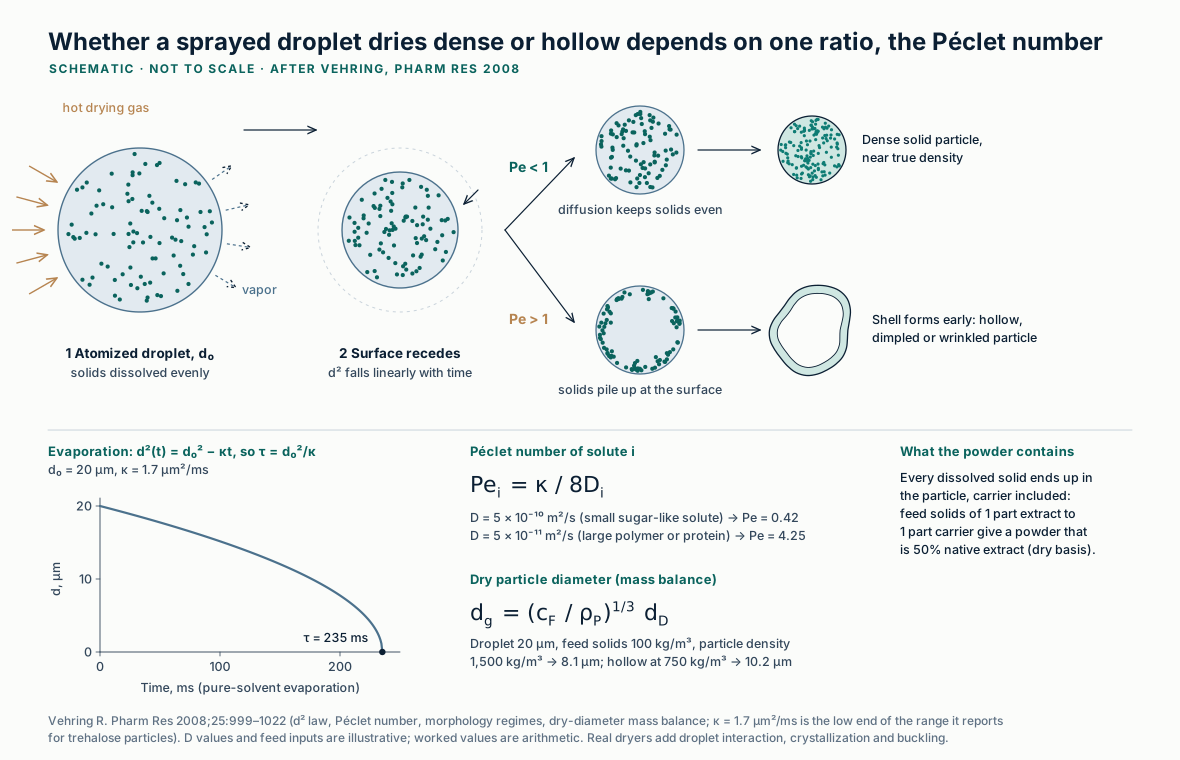
In a spray-dried extract every dissolved solid, carrier included, ends up in the particle, and the Péclet number decides whether it dries dense or hollowPeer-reviewed model
Vehring R. Pharmaceutical particle engineering via spray drying. Pharm Res 2008;25(5):999–1022 (d² law, Péclet number, morphology regimes, particle-size mass balance). Diffusion coefficients and feed inputs illustrative. Generated illustration, EUTECNIQ. Full-size SVGMethod, assumptions and limits
What it calculates
Dry mode: genuine extract and carrier per unit, the herbal-substance equivalent from the DER genuine range, herb per unit of finished extract, and the marker carried. Liquid mode: the concentration after part of the solvent is removed, and the starting material in a serving.
Equations
Dry: E = m × f; carrier = m − E; herb = E × DER; herb per unit finished extract = DER × f; marker in the genuine extract = marker / f. Liquid: y : z(1 − r); starting material = V × y / (z(1 − r)).
Variables and units
m dry extract per unit (mg); f genuine fraction; DER herb : genuine extract (mass : mass); y starting material (g); z solvent (mL); r fraction of solvent removed; V final extract (mL).
Assumptions
The DER genuine and the genuine fraction are known from the manufacturing record. A marker stated for the finished extract cannot exceed the genuine fraction; the tool flags that case.
Identity, potency, equivalence to the whole herb, or any effect. A DER describes manufacture, not activity, and the EMA rules apply to EU herbal medicinal products, not to U.S. supplements. Not a dose recommendation.
Benchmarks reproduced: EMA valerian example (200 mg, 80%, DER 3–6 : 1 → 160 mg, 480–960 mg root); EMA horse chestnut example (19% of 200 mg = 38 mg); 21 CFR example (1:5, 50% removed → 1:2.5). Unit tests and the Python reference recompute every readout.
In EMA's worked example, 200 mg of valerian dry extract holds 160 mg of genuine extract, equivalent to 480–960 mg of root.
Explanation, details and sources
Why carriers. Many extracts are sticky or hygroscopic once the solvent is gone, so a carrier such as maltodextrin or gum arabic is added before or during drying; the spray-dryer stickiness (glass transition) explorer on Scale-up and tech transfer shows why. FDA lists maltodextrin as affirmed GRAS with a dextrose equivalent below 20, made from corn, potato or rice starch (21 CFR 184.1444), and acacia (gum arabic) with maximum levels by food category (184.1330).
EMA definitions, quoted. “Genuine (Native) herbal preparation: refers to the preparation without excipients, even if for technological reasons the genuine herbal preparation is not available.” The ratio of herbal substance to genuine herbal preparation (DER genuine) “is the ratio of the quantity of the herbal substance to the quantity of the resulting genuine herbal preparation.” “Other excipients are technological excipients (e.g. carrier substances) which may be part of herbal preparations.”
The worked example. EMA's “Dry extract from Valerian root”: genuine extract 80%, DER genuine 3–6 : 1, other excipients 20%, 200 mg per capsule; the declaration reads “Each capsule contains 160 mg of extract (as dry extract) … (equivalent to 480 mg – 960 mg of Valerian root).”
U.S. rule for liquids. 21 CFR 101.36(b)(3)(ii)(B) describes “y:z” as the weight of starting material to the volume of solvent, and “if the original extract was 1:5 and 50 percent of the solvent was removed, then the final concentration shall be stated as 1:2.5.” For an extract dried to remove the solvent, “the weight of the ingredient shall be the weight of the dried extract” (101.36(b)(3)(ii)(C)).
Sources: EMA, Guideline on declaration of herbal substances and herbal preparations in herbal medicinal products/traditional herbal medicinal products, EMA/HMPC/CHMP/CVMP/287539/2005 Rev.1; 21 CFR 101.36, 184.1330, 184.1444 (eCFR, October 22, 2026).
6 · Flow and compaction
Flow agents and lubricants change how a powder flows and compacts, which USP <1174> grades on a seven-step scale
The scale of flowability: compressibility index, Hausner ratio and angle of reposeHarmonized pharmacopeial text
USP <1174> Powder Flow, harmonized with Ph. Eur. 2.9.36 and JP: Tables 1 and 2 of the PDG text (003-2003PDG), published by PMDA.Data table: the seven classes
Scale of flowability (PDG harmonized text)
Flow character
Compressibility index, %
Hausner ratio
Angle of repose, degrees
Excellent
1–10
1.00–1.11
25–30
Good
11–15
1.12–1.18
31–35
Fair
16–20
1.19–1.25
36–40
Passable
21–25
1.26–1.34
41–45
Poor
26–31
1.35–1.45
46–55
Very poor
32–37
1.46–1.59
56–65
Very, very poor
> 38
> 1.60
> 66
USP <1174>, from untapped (V0) and tapped (Vf) bulk volumeCompressibility index = 100 × (V0 − Vf) / V0 Hausner ratio = V0 / Vf
How a glidant and a lubricant act, and what too much lubricant doesSchematic
Not to scale. Li J, Wu Y. Lubricants 2014;2(1):21–43; 21 CFR 172.480 and 184.1440.
Both indices depend on the test method, so compare only values measured the same way. A classifier and scale-up rules are on Scale-up and tech transfer.
Explanation, details and sources
The harmonized text calls the indices “not intrinsic properties of the powder” and lists what moves them: cylinder diameter and mass, number of taps, drop height, sample mass and rotation. It recommends a 250 mL cylinder with 100 g of sample. On angle of repose it notes “examples in the literature of formulations with an angle of repose in the range of 40-50 degrees that manufactured satisfactorily. When the angle of repose exceeds 50 degrees, the flow is rarely acceptable for manufacturing purposes.”
Lubricants work mainly by boundary lubrication: “they decrease friction at the interface between a tablet's surface and the die wall during ejection” (Li and Wu 2014). The same review warns that “use of too much lubricant in tablet formulations can impact the product performance by decreasing tablet dissolution” and that “over-mixing often causes dissolution delay”; it gives a typical lubricant mixing time of 0.5–5 minutes.
Sources: PDG harmonized text “Powder Flow” (003-2003PDG), https://www.pmda.go.jp/files/000233963.pdf; Li and Wu 2014, doi:10.3390/lubricants2010021.
7 · What excipients carry
Minor excipients can carry most of an impurity budget, and some come from major food allergens
Daily elemental-impurity mass by component in ICH's example tablet (µg per day)ICH illustrative example
ICH Q3D(R2) (2022), Appendix 4, Table A.4.8: measured concentrations in an illustrative risk assessment times each component's daily intake. – : below the limit of quantitation, or palladium not assessed in excipients.Data table: Table A.4.8 daily masses
Total daily mass of each elemental impurity, µg (ICH Q3D(R2) Table A.4.8)
Component (g/day)
Pb
As
Cd
Hg
Pd
V
Ni
Drug substance (0.2)
0
0.1
0
0
4
0
10
Microcrystalline cellulose (1.1)
0.11
0.11
0.11
0.11
0
0
0
Lactose (0.45)
0.045
0.045
0.045
0.045
0
0
0
Calcium phosphate (0.35)
0.35
0.35
0.35
0.35
0
3.5
1.75
Crospovidone (0.265)
0.0265
0.0265
0.0265
0.0265
0
0
0
Magnesium stearate (0.035)
0.0175
0.0175
0.0175
0.0175
0
0
0.0175
HPMC (0.06)
0.006
0.006
0.006
0.006
0
0
0
Titanium dioxide (0.025)
0.5
0.025
0.025
0.025
0
0.025
0
Iron oxide (0.015)
0.15
0.15
0.15
0.15
0
6
0.75
Total, as printed
1.2
0.8
0.7
0.7
4
9.5
12.5
The guideline prints 0 where a concentration was below the limit of quantitation and where palladium was not assessed. The lead column sums to 1.205 µg, printed as 1.2.
Sources named in the regulations, and the major food allergen each could bring21 CFR; FALCPA
21 CFR 168.122, 184.1090, 184.1400, 184.1440, 184.1444 (eCFR, October 22, 2026); EDQM PDG table (September 1, 2026); DSLD sample (October 24, 2026); FDA, “Food Allergies: What You Need to Know” (March 11, 2026).
In ICH's example, titanium dioxide and iron oxide are 1.6% of the mass but supply 54% of the lead.
Explanation, details and sources
The lead in the example comes mostly from two colorants and a filler: titanium dioxide 0.5 µg, calcium phosphate 0.35 µg and iron oxide 0.15 µg of 1.205 µg. Iron oxide supplies 6 of the 9.5 µg of vanadium, and the drug substance 10 of the 12.5 µg of nickel. The elemental budget calculator in Course 6 reproduces this table.
Allergens. FDA lists nine major food allergens: “milk, eggs, fish, Crustacean shellfish, tree nuts, peanuts, wheat, soybeans, and sesame”; sesame became the ninth under the FASTER Act, effective January 1, 2023. FDA states that the labeling law applies to dietary supplements. The food source is declared “in parentheses following the name of the ingredient”, e.g. “lecithin (soy)”, or in a “Contains” statement.
Sources: ICH Q3D(R2), https://database.ich.org/sites/default/files/Q3D-R2_Guideline_Step4_2022_0308.pdf; FDA, https://www.fda.gov/food/nutrition-food-labeling-and-critical-foods/food-allergies.
8 · “Inert” in pesticide law
In pesticide law “inert ingredient” is a defined term with its own tolerance exemptions, and EPA lets labels say “Other ingredients”
Entries in each tolerance-exemption table of 40 CFR 180 Subpart D40 CFR 180, counted from eCFR
Rows of the tables in 40 CFR 180.910–180.960, eCFR XML up to date as of October 22, 2026, counted October 24, 2026. Plain-English summaries of 40 CFR Parts 152 and 180: CFR atlas.Data table: entries per section
Table entries in 40 CFR 180 Subpart D
Section
Scope
Entries
180.910
Inert ingredients used pre- and post-harvest
390
180.920
Inert ingredients used pre-harvest
229
180.930
Inert ingredients applied to animals
225
180.940
Active and inert ingredients in food-contact surface sanitizing solutions (three tables: 713, 30, 76)
819
180.950
Minimal-risk active and inert ingredients
83
180.960
Polymers
281
The same substances under FDA food rules and EPA pesticide-inert exemptions21 CFR and 40 CFR 180
21 CFR and 40 CFR 180.910–180.950 (eCFR, up to date as of October 22, 2026). Functions as printed in each listing.
Magnesium stearate is a “lubricant and release agent” in FDA's listing and a “surfactant” in EPA's: one substance, two legal vocabularies.
Explanation, details and sources
40 CFR 152.3: “Inert ingredient means any substance (or group of structurally similar substances if designated by the Agency), other than an active ingredient, which is intentionally included in a pesticide product, except as provided by § 174.3 of this chapter.” An inert ingredient that may leave residues in food needs a tolerance or an exemption from one, listed in 40 CFR 180 Subpart D.
EPA PR Notice 97-6 lets registrants replace the heading “Inert ingredients” with “the more neutral term ‘Other ingredients’”, because many consumers took “inert” to mean “water or other harmless ingredients”. EPA adds that “some inert ingredients are not benign to human health or the environment.”
A boundary in the text. 40 CFR 180.950(a)(2)(iv) excludes dietary supplements from the “commonly consumed food commodities” that are exempt as minimal-risk pesticide ingredients.
Any constituent of a dosage unit other than the active or dietary ingredient, added for manufacture, stability or use.
Other ingredients
The heading of a supplement's ingredient statement when sources are named in the Supplement Facts panel (21 CFR 101.4(g)).
Other dietary ingredients
Dietary ingredients without Daily Values, declared inside the panel (101.36(b)(3)); not the same as “Other ingredients”.
Filler (diluent)
Bulk that brings a small dose to a mass a machine can fill or compress.
Binder
A material that holds particles together in a granule or tablet.
Disintegrant
A material that breaks a tablet apart once it is wet.
Glidant (flow agent)
Fine particles that reduce cohesion so a powder flows; in food law, an anticaking or free-flow agent.
Lubricant
A material that lowers friction between powder and tooling, such as magnesium stearate.
Carrier
A technological excipient, such as maltodextrin, added to an extract, often to make drying possible.
DER genuine
The ratio of herbal substance to the genuine extract obtained, excluding excipients (EMA definition).
GRAS
Generally recognized as safe by qualified experts for a stated use; exempt from the food-additive definition.
Inert ingredient (EPA)
Any intentionally added substance in a pesticide product other than an active ingredient (40 CFR 152.3).
Check your understanding
Five questions on other ingredients
A capsule lists “Calcium (as calcium carbonate)” in the panel. Is calcium carbonate repeated below, and what is the heading?
No, and the heading is “Other ingredients”. A source named in the panel need not be repeated (101.36(d)), and naming sources in the panel switches the heading from “Ingredients” to “Other ingredients” (101.4(g)).
Magnesium stearate is 1.0% and rice flour 4.0% of a capsule. Which may follow “Contains 2% or less of”?
Only magnesium stearate. Under 101.4(a)(2), no ingredient in that group may exceed the stated threshold.
Does the supplement exemption from the food-additive definition cover silicon dioxide?
No. It covers dietary ingredients. FDA's 2014 guidance says binders, excipients and fillers must be used under a food-additive regulation or be GRAS; for silicon dioxide, 172.480 sets at most 2% by weight.
A dry extract is 200 mg, 80% genuine extract, DER genuine 3–6 : 1. How much herb does one unit correspond to?
480–960 mg: 160 mg of genuine extract times 3 to 6. Dividing by the whole 200 mg, carrier included, would give 2.4–4.8 : 1, a different number for the same product.
Is an “inert ingredient” on a pesticide label harmless by definition?
No. 40 CFR 152.3 defines it only as a substance other than the active ingredient. EPA notes that some inert ingredients are not benign and allows the heading “Other ingredients” instead.
Back to the Academy
Course 6 shows how the impurities excipients carry are tested and limited.