

EUTECNIQ Sciences

See every page on one mapArrow keys move through results · Enter opens · Esc closes

Academy · Course 9 Agency guidance and published data Calculators

Toxicity is a property of dose, so a safety conclusion compares human exposure with a measured reference point

A safety assessment from the dose–response curve to a judgment about intake: LD50s, NOAELs and benchmark doses, the uncertainty factors and margins of exposure that turn them into decisions, and what two-year botanical studies found.

Level
Intermediate
Reading time
About 30 minutes
Builds on
Solubility and pH · Toxicology programs
Tools
3 calculators, 1 incidence explorer, 1 heat map
100default uncertainty factor: 10 between species × 10 among people
10,000margin of exposure EFSA treats as low concern for a genotoxic carcinogen
0.0025µg/kg bw per day, EFSA’s TTC for a possible DNA-reactive carcinogen
38/50male mice with hepatoblastoma at the top Ginkgo-extract dose, against 3/50 in controls (NTP TR-578)
At a glance

In NTP two-year studies of four botanical materials, every finding peaked at the top dose; Ginkgo extract took male-mouse hepatoblastoma from 3 to 38 of 50

Tumor incidence by dose group in four NTP botanical bioassays (choose a finding)NTP Technical Reports
NTP Technical Reports TR-578 (Ginkgo biloba extract), TR-571 (kava kava extract), TR-562 (goldenseal root powder) and TR-577 (Aloe vera whole-leaf extract), summary tables. Rodent findings at high doses; they do not by themselves establish human risk at intake levels.
Data table: incidences by dose group
Animals with the finding / animals examined, control to high dose
FindingStudy and dosesControlLowMidHigh
Ginkgo extract · male mice · hepatocellular carcinomaTR-578 · 0, 200, 600, 2,000 mg/kg, gavage22/5031/5041/5047/50
Ginkgo extract · male mice · hepatoblastomaTR-578 · 0, 200, 600, 2,000 mg/kg, gavage3/5028/5036/5038/50
Ginkgo extract · female mice · hepatocellular adenomaTR-578 · 0, 200, 600, 2,000 mg/kg, gavage17/5037/5041/5048/50
Ginkgo extract · female mice · hepatocellular carcinomaTR-578 · 0, 200, 600, 2,000 mg/kg, gavage9/5010/5015/5044/50
Ginkgo extract · male rats · thyroid follicular adenomaTR-578 · 0, 100, 300, 1,000 mg/kg, gavage2/501/503/495/45
Kava extract · male mice · hepatoblastomaTR-571 · 0, 0.25, 0.5, 1.0 g/kg, gavage0/504/509/5012/50
Goldenseal · male rats · hepatocellular adenoma or carcinomaTR-562 · 0, 3,000, 9,000, 25,000 ppm in feed1/501/502/5011/50
Goldenseal · female rats · hepatocellular adenomaTR-562 · 0, 3,000, 9,000, 25,000 ppm in feed0/500/501/508/50
Goldenseal · male mice · hepatoblastomaTR-562 · 0, 3,000, 9,000, 25,000 ppm in feed1/502/501/506/50
Aloe vera · male rats · large intestine adenoma or carcinomaTR-577 · 0, 0.5, 1, 1.5% in drinking water0/470/4828/4831/48
Aloe vera · female rats · large intestine adenoma or carcinomaTR-577 · 0, 0.5, 1, 1.5% in drinking water0/480/488/4815/48

You will learn

  1. Why a NOAEL depends on study design while a BMDL uses the whole curve.
  2. What an LD50 measures and why OECD deleted its classical test in 2002.
  3. Which study design answers which safety question.
  4. How uncertainty factors give a daily intake, and how to compute a margin of exposure.
  5. When EFSA's threshold of toxicological concern applies.
  6. How to read NTP botanical bioassays without overstating them.

Status. EUTECNIQ Sciences is a company in formation with no laboratory, study data or testing agreements. This course gives no dosing advice.

1 · Dose–response

Every substance has a dose–response curve, and safety work locates human exposure on it

Log-logistic model with background (U.S. EPA 2012, Appendix C)P(d) = γ + (1 − γ) · dn ⁄ (dn + ED50n)  ·  extra risk = [P(d) − γ] ⁄ (1 − γ)

P: fraction of animals with the effect; d: dose, mg/kg body weight per day; γ: background incidence; ED50: dose giving half the maximum effect above background; n: slope. Extra risk definition: U.S. EPA, Benchmark Dose Technical Guidance (2012), glossary.

One curve, six reference terms: the NOAEL must be a tested dose, the BMD need not beIllustrative model, not data
Illustrative quantal dose-response curve: background 5%, benchmark response 10% extra risk at 14.5% incidence, benchmark dose 50 with a 32 to 79 confidence interval from a simulated study, NOAEL 33 and LOAEL 100 mg/kg bw per day0%25%50%75%100%1033.31003001,0000Dose, mg/kg body weight per day (log scale)Animals with the effectBackground 5%BMR: 10% extra risk (14.5%)Model: log-logistic, background 5%, ED50 150, slope 2Model curveED50 150control: 3 of 50 animals33.3 mg/kg: 5 of 50 animals100.0 mg/kg: 17 of 50 animals300.0 mg/kg: 41 of 50 animals41/5017/50BMDL 32.2 to BMDU 79.1 (profile likelihood, fitted to the simulated counts)BMD 50 (from the model)BMD 50Interval 32 to 79 (BMDL to BMDU)NOAELLOAELRead the curveBackgroundResponse in the control group: 5% here.Benchmark response (BMR)A chosen change over background. For incidencedata, 10% extra risk is the usual default.BMDDose that gives the BMR on the fitted curve: 50mg/kg bw per day for this model.BMDL and BMDULower and upper confidence bounds on the BMDfrom the study data: 32 to 79 here. The BMDL is theusual reference point.NOAEL and LOAELHighest tested dose with no significant adverseeffect (33) and the next dose (100). Both must bedoses the study used.ED50Dose that gives half of the maximum effect abovebackground: 150.Illustrative model, not data: log-logistic, background 5%, ED50 150, slope 2; simulated study of 50 animals per group at 0, 33, 100 and 300 mg/kg bw per day (3, 5, 17 and 41affected); NOAEL by one-sided Fisher test, p < 0.05.
Model and parameters stated in the figure; values computed with this page's explorer and checked against an independent Python implementation. Definitions: EFSA Scientific Committee (2022), sections 2.3 and 2.6; U.S. EPA (2012). A benchmark-dose model explorer on EFSA 2022 data is on the toxicology page.
Text version of the curve

An illustrative log-logistic curve with 5% background, ED50 150 and slope 2 mg/kg bw per day. A simulated study of 50 animals per group at 0, 33, 100 and 300 mg/kg bw per day gives 3, 5, 17 and 41 affected animals. A one-sided Fisher test against control is not significant at 33 and is significant at 100, so the NOAEL is 33 and the LOAEL is 100. A benchmark response of 10% extra risk corresponds to 14.5% incidence; the model's BMD is 50, and the fit to the simulated counts gives a BMD of 52.5 with a 90% interval (BMDL to BMDU) of 32 to 79.

Explanation, details and sources

Paracelsus put it as "All things are poison and nothing is without poison. Solely the dose determines that a thing is not a poison" (translation in Grandjean 2016). For incidence data, the fraction of animals affected rises from a background level along an S-shaped curve.
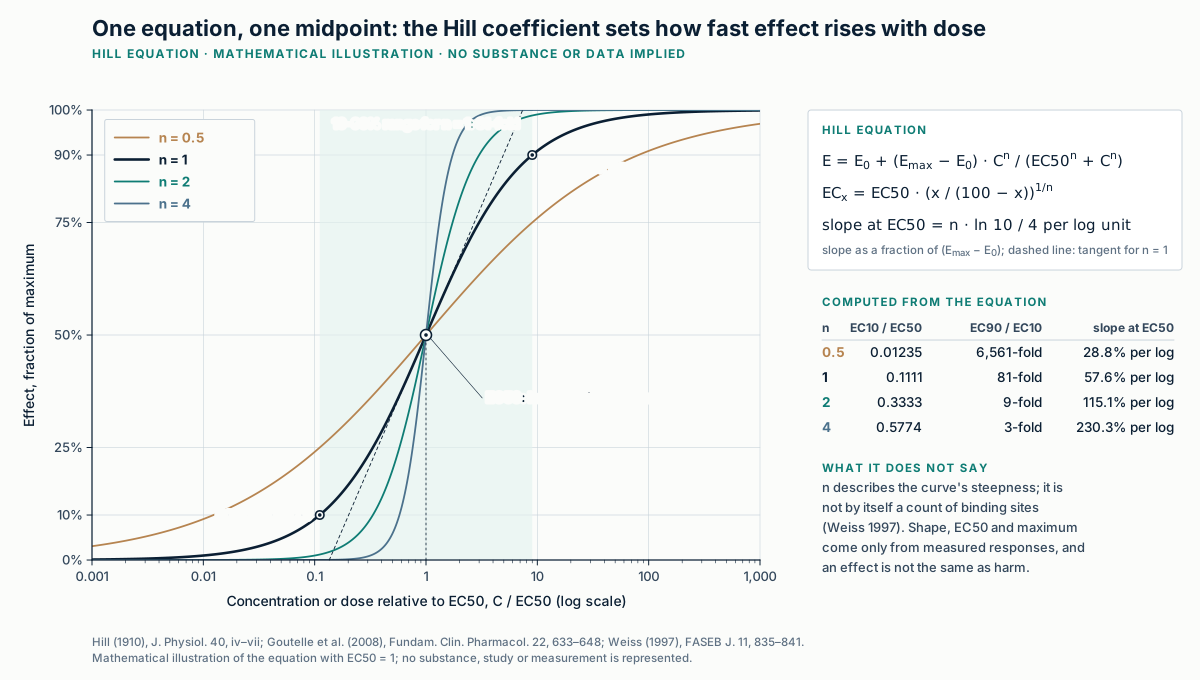
The Hill coefficient sets steepness: the 10–90% effect range is 81-fold at n = 1 and 3-fold at n = 4Mathematical illustration
Fraction of the maximum effect against concentration relative to the EC50, on a logarithmic axis from one thousandth to one thousand, for Hill coefficients 0.5, 1, 2 and 4. All curves pass through half the maximum at the EC50; a larger coefficient makes the rise steeper, so the range from 10% to 90% effect shrinks from 6,561-fold at 0.5 to 81-fold at 1 and 3-fold at 4. A mathematical illustration of the equation, not data on any substance.
Hill AV. J Physiol 1910;40:iv–vii; Goutelle S et al. Fundam Clin Pharmacol 2008;22:633–648; Weiss JN. FASEB J 1997;11:835–841. Equation only; no substance or data. Generated illustration, EUTECNIQ. Full-size SVG
2 · Acute toxicity

The LD50 ranks acute lethality, and OECD replaced its classical test with designs using 5 to 9 animals

Four dates and four designs: from Trevan's LD50 to fixed-dose, acute-toxic-class and up-and-down testsFrom OECD documents
From the LD50 to methods with fewer animals: Trevan defined the LD50 in 1927; OECD reduced TG 401 from 30 to 20 animals in 1987, adopted updated TG 420, 423 and 425 in December 2001 and deleted TG 401 on December 17, 2002Timeline19201930194019501960197019801990200020101927 · LD50 definedTrevan: the dose that kills 50% of a largegroup of animals1987 · TG 401 revisedAnimals per test cut from 30 to 20Dec 2001 · TG 420, 423, 425Updated alternatives adoptedDec 17, 2002 · TG 401 deletedOne year after the alternativesAnimals per test (OECD Guidance Document 24, 2001)What ends the testTG 401 Acute oral toxicityDeleted 2002TG 401 before the 1987 revision: 30 animals per testTG 401 Acute oral toxicity: at least 20 (30 before 1987)at least 20 (30 before 1987)Deaths at several doses; LD50 by calculationTG 420 Fixed dose procedure5 animals per doseTG 420 Fixed dose procedure: 5–7 in most tests5–7 in most testsEvident toxicity, not death; fixed doses 5, 50,300, 2000 mg/kgTG 423 Acute toxic class3 animals per stepTG 423 Acute toxic class: average 7average 7Deaths in steps of three; GHS hazard categoryTG 425 Up-and-down1 animal at a timeTG 425 Up-and-down: about 6–9about 6–9Sequential dosing; LD50 with a confidenceinterval0102030Animals
Trevan JW. Proc R Soc Lond B. 1927;101:483–514. OECD C(2001)282 (draft Council Decision: deletion of TG 401, adoption of updated TG 420, 423, 425; 1987 reduction from 30 to 20 animals). OECD Test No. 401 (deleted December 17, 2002). OECD Guidance Document 24 on acute oral toxicity testing, ENV/JM/MONO(2001)4, paragraphs 9 and 12–16. OECD TG 420 (2002) and TG 425 (2022) summaries.
Data: animals per test and endpoints
GuidelineAnimals per testEndpointSource
TG 401 Acute oral toxicity (deleted 2002)at least 20 (30 before the 1987 revision)Deaths at several doses; LD50 calculatedGD 24 ¶13; C(2001)282 ¶10
TG 420 Fixed dose procedure5–7 in most tests"Clear signs of toxicity", not death; doses 5, 50, 300, 2000 mg/kgGD 24 ¶9, ¶14; TG 420
TG 423 Acute toxic classaverage 7Deaths in steps of three animals; GHS categoryGD 24 ¶15
TG 425 Up-and-down procedureabout 6–9One animal at a time, usually 48 h apart; LD50 with a confidence intervalGD 24 ¶12, ¶16; TG 425
Explanation, details and sources

Trevan defined the median lethal dose in 1927 as "the dose which kills 50 per cent. of a large group of animals". OECD deleted Test Guideline 401 on December 17, 2002, one year after adopting updated alternatives. Studies started before that date remain acceptable under Mutual Acceptance of Data.

An LD50 or a GHS category ranks acute hazard; it says nothing about a safe daily intake. The TG 423 simulator on the toxicology page walks through the stepwise rules.

3 · Study designs

Studies run from hours to two years, and each answers a narrower question than the one before

Five tiers, with in-life periods from hours to 24 months on a log scaleFrom the guideline texts
Five study tiers, each answering a narrower question: genotoxicity screens, 28-day, 90-day, reproductive and developmental, and lifetime chronic and carcinogenicity studies; 28-day data precede the 90-day study, whose NOAEL sets chronic doses1 Genotoxicity screenDoes it damage DNA?TG 471 Ames: pointmutations in 5 bacterialstrains, ± S9TG 487: micronuclei fromclastogens and aneugensTG 474: micronucleus invivoHours to 3 days2 Short repeated doseWhich organs, at whichdoses?TG 407: 28 days of dailydosingInforms dose selection forlonger studies28 days3 SubchronicWhat is the NOAEL forprolonged dosing?TG 408: 90 days, ≥ 10rodents per sex pergroup, ≥ 3 doses + controlIts NOAEL selects chronicdoses90 days4 ReproductionFertility, pregnancy,offspring?TG 414: prenataldevelopmentTG 443: one-generationstudy with neurotoxicityand immunotoxicitycohortsWeeks to months5 LifetimeChronic toxicity andtumours?TG 452: 12 monthsTG 451: 24 months, ≥ 50per sex per groupTG 453: both in one study12 to 24 monthsIts NOAEL sets chronic doses (TG 408)Accent arrows follow TG 408; other positions are not prescribedIn-life period, log scale (from the guideline texts)Minimum animals: TG 408 at least 80 (10 per sex, 4 groups); TG 451 at least 400 (50 per sex, 4 groups)TG 487 treatment, 3–6 hTG 487 treatment, 3–6 hTG 471 incubation, 2–3 daysTG 471 incubation, 2–3 daysTG 407, 28 daysTG 407, 28 daysTG 408, 90 daysTG 408, 90 daysTG 452, 12 monthsTG 452, 12 monthsTG 451, 24 monthsTG 451, 24 months1 h1 day1 week1 month1 year2 yearsFive study tiers from genotoxicity screens to lifetime studies1 Genotoxicity screenDoes it damage DNA?TG 471 Ames: point mutations in 5 bacterial strains, ±S9TG 487: micronuclei from clastogens and aneugensTG 474: micronucleus in vivoHours to 3 days2 Short repeated doseWhich organs, at which doses?TG 407: 28 days of daily dosingInforms dose selection for longer studies28 days3 SubchronicWhat is the NOAEL for prolonged dosing?TG 408: 90 days, ≥ 10 rodents per sex per group, ≥ 3doses + controlIts NOAEL selects chronic doses90 days4 ReproductionFertility, pregnancy, offspring?TG 414: prenatal developmentTG 443: one-generation study with neurotoxicity andimmunotoxicity cohortsWeeks to months5 LifetimeChronic toxicity and tumours?TG 452: 12 monthsTG 451: 24 months, ≥ 50 per sex per groupTG 453: both in one study12 to 24 months
OECD Test Guidelines 471 (adopted 1997, corrected 2020), 487 (2016, corrected 2023), 474 (2016), 407, 408 and 443 (2025), 414, 451, 452 and 453 (2018). Arrows follow TG 408's own text (28-day data before the 90-day study; its NOAEL sets chronic doses); other positions are not prescribed, and FDA's NDI guidance says firms are not required to complete every study in a row of its table.
Which study answers which questionSummarized from OECD purpose statements
Which study answers which question: gene mutation from the Ames test, chromosome damage from micronucleus tests, target organs and NOAELs from repeated-dose studies, fertility and development from reproductive studies, tumours from lifetime studiesGene mutationChromosomedamageTarget organsNOAEL,repeateddosingFertilityDevelopmentTumoursTG 471 Bacterial reverse mutationTG 471 Bacterial reverse mutation · Gene mutation: highTG 487 In vitro micronucleusTG 487 In vitro micronucleus · Chromosome damage: highTG 474 In vivo micronucleusTG 474 In vivo micronucleus · Chromosome damage: highHepatocyte models (no single TG)Hepatocyte models (no single TG) · Target organs: mediumTG 407 Repeated dose, 28 daysTG 407 Repeated dose, 28 days · Target organs: highTG 407 Repeated dose, 28 days · NOAEL, repeated dosing: highTG 408 Repeated dose, 90 daysTG 408 Repeated dose, 90 days · Target organs: highTG 408 Repeated dose, 90 days · NOAEL, repeated dosing: highTG 414 Prenatal developmentalTG 414 Prenatal developmental · Development: highTG 443 Extended one-generationTG 443 Extended one-generation · Target organs: highTG 443 Extended one-generation · NOAEL, repeated dosing: highTG 443 Extended one-generation · Fertility: highTG 443 Extended one-generation · Development: highTG 452 Chronic toxicityTG 452 Chronic toxicity · Target organs: highTG 452 Chronic toxicity · NOAEL, repeated dosing: highTG 451 CarcinogenicityTG 451 Carcinogenicity · Target organs: mediumTG 451 Carcinogenicity · NOAEL, repeated dosing: mediumTG 451 Carcinogenicity · Tumours: highTG 453 Chronic + carcinogenicityTG 453 Chronic + carcinogenicity · Target organs: highTG 453 Chronic + carcinogenicity · NOAEL, repeated dosing: highTG 453 Chronic + carcinogenicity · Tumours: highStated objective of the guidelinePartial or secondary informationNot addressedFrom each guideline's statement of purpose
Purpose paragraphs of TG 471, 487, 474, 407, 408, 414, 443, 451, 452 and 453; hepatocyte models: Weaver RJ et al. Nat Rev Drug Discov. 2020;19:131–148. A qualitative symbol matrix, not a heat map of data.
Text version of the tiers and the matrix
  • Genotoxicity. TG 471 detects point mutations "which involve substitution, addition or deletion of one or a few DNA base pairs"; TG 487 detects micronuclei from clastogens and aneugens; TG 474 detects chromosome or mitotic damage in erythroblasts in vivo.
  • Repeated dose. TG 407 doses daily for 28 days. TG 408 doses for at least 90 days with at least 20 animals (ten of each sex) per dose and at least three doses plus a control; it indicates target organs and can estimate a NOAEL.
  • Reproduction and development. TG 414 covers effects of prenatal exposure "on the pregnant test animal and on the developing organism". TG 443 covers fertility, development and optional neurotoxicity and immunotoxicity cohorts, with NOAELs for each endpoint.
  • Lifetime. TG 452 normally runs 12 months; TG 451 normally 24 months in rodents with at least 50 animals per sex per group; TG 453 combines them.
Explanation, details and sources

OECD's 90-day guideline "may be carried out after initial information on toxicity has been obtained from acute or repeated dose 28-day toxicity tests", and its NOAEL "can be used in selecting dose levels for chronic studies". A bacterial mutation test needs two or three days of incubation; a carcinogenicity study needs two years.

Efficacy is a separate question with its own standard of proof; human trials are covered on the clinical research page, and the full guideline catalog and GLP rules are on the toxicology page.

4 · Reference points

A NOAEL is always a dose the study tested; a benchmark dose is estimated from the whole curve

Benchmark dose for the log-logistic model (extra risk)BMD = ED50 · [BMR ⁄ (1 − BMR)]1/n

Doses in mg/kg body weight per day.

BMD of the model33.3
NOAEL of the study33.3
LOAEL of the study100
Fitted BMD35
BMDL (lower bound)21.8
BMDU (upper bound)52.7

The study's NOAEL is a tested dose; the BMDL is estimated from all four groups.

Study groups, the fitted curve and the benchmark dose intervalSimulation; one option uses published data
Groups of the current study
DoseAffected / groupIncidenceFisher p vs control
03 / 506%control
33.37 / 5014%0.16
10026 / 5052%< 0.001
30045 / 5090%< 0.001
Illustrative mode: counts are the model's expected values, rounded. The published option fits the NTP riddelliine counts and reproduces EFSA's log-logistic result (BMD10 278.32, BMDL10 216.29, BMDU10 345.24 µg/kg bw per day).
Method, assumptions and limits
What it calculates
The benchmark dose of a chosen log-logistic curve; a simulated study of a control and three doses; the NOAEL and LOAEL of that study; and the maximum-likelihood BMD with its profile-likelihood bounds (BMDL, BMDU) fitted to the study counts.
Equations
P(d) = γ + (1 − γ)·dⁿ/(dⁿ + ED50ⁿ). Extra risk: (P − γ)/(1 − γ) = BMR; added risk: P − γ = BMR. BMD = ED50·(F/(1 − F))^(1/n), with F = BMR for extra risk or BMR/(1 − γ) for added risk. Simulated affected animals = round(N·P(d)). Doses: top/s², top/s, top. Fit: binomial log-likelihood maximised over γ, ED50 and n (Nelder–Mead). Bounds: BMD values where the profile log-likelihood falls by χ²(1; 0.90)/2 = 1.353, a one-sided 95% bound on each side, as described in U.S. EPA (2012) section 2.3.8.
Variables and units
Doses in mg/kg bw per day (µg/kg bw per day for the published data). γ: 0–30%. ED50: 1–1,000. n: 1–8 for the illustrative curve; the fit bounds n to 1–50 (the lower bound follows EPA's usual restriction β ≥ 1). BMR 1%, 5% or 10%. Group size 10, 20 or 50. NOAEL/LOAEL: one-sided Fisher exact test of each group against control, p < 0.05.
Assumptions
One model only; EFSA (2022) recommends Bayesian model averaging over several models, which gives different numbers for the same data. Expected counts remove sampling noise, so the illustrative fit is idealized. Each animal responds independently.
Valid range
Quantal (yes/no) endpoints only. When every dose responds near 100% or the top group barely responds, the slope is poorly constrained; the explorer says so.
What it does not establish
It is not a risk assessment: it does not judge adversity, study quality, human relevance or the choice of BMR, and the illustrative curves are invented.
Verification
Published benchmark: NTP TR-508 riddelliine, liver haemangiosarcoma in female rats, doses adjusted by EFSA (2017, Appendix B): log-logistic BMD10 278.32 (EFSA: 278.32), BMDL10 216.33 (216.29), BMDU10 345.16 (345.24). Six cases are checked against an independent scipy implementation (tests/numerics/ref/academy_toxicology-and-dose.py).
References
U.S. EPA Risk Assessment Forum, Benchmark Dose Technical Guidance, EPA/100/R-12/001 (2012); EFSA Scientific Committee, EFSA J. 2022;20(10):e07584; EFSA CONTAM Panel, EFSA J. 2017;15(7):4908, Appendix B; NTP TR-508 (2003); Crump KS, Fundam Appl Toxicol. 1984;4:854–871.
Worked example: riddelliine gives a NOAEL of 236 but a BMDL10 of 216 to 237 µg/kg bw per dayPublished data and analysis
Riddelliine in female rats (NTP TR-508): liver haemangiosarcoma in 0 of 50 animals up to 71 µg/kg bw per day, 3 of 50 at 236 and 38 of 50 at 714; EFSA's log-logistic BMD10 is 278 with a BMDL10 of 216, and its model-averaged BMDL10 of 237 is the reference point0%25%50%75%100%310301003001,0000Dose, µg/kg body weight per day (log scale; NTP doses × 5/7 for 5-day-a-week gavage)Female rats with liver haemangiosarcomaLog-logistic fit: background 0, ED50 516, slope 3.56BMR 10% extra riskLog-logistic BMDL10 216.29 to BMDU10 345.24Log-logistic BMD10 278.320 µg/kg bw per day: 0 of 507 µg/kg bw per day: 0 of 5024 µg/kg bw per day: 0 of 5071 µg/kg bw per day: 0 of 50236 µg/kg bw per day: 3 of 50714 µg/kg bw per day: 38 of 5038/503/50BMDL10 216 · BMD10 278NOAEL 236LOAEL 714Reference points, µg/kg bw per dayNOAEL / LOAEL236 / 714Fisher test of the published counts (this page)Log-logistic BMD10278 (216–345)EFSA 2017 Appendix B; this page's explorerreproduces itModel-averaged BMD10293 (237–548)EFSA 2017 Appendix B, six modelsReference point237EFSA 2017: the model-averaged BMDL10At 236, 3 of 50 rats had tumours, but theincrease was not significant, so 236 is theNOAEL. The BMDL10 sits below it because thefitted curve counts that response.Data: NTP TR-508 (2003), female F344/N rats, 50 per group. Analysis: EFSA CONTAM Panel (2017), Appendix B (PROAST 61.3).
NTP. Technical Report 508, riddelliine (May 2003). EFSA CONTAM Panel. EFSA J. 2017;15(7):4908, Appendix B: doses × 5/7 for gavage 5 days a week; BMR 10% extra risk; PROAST 61.3. NOAEL and LOAEL derived here from the published counts.
Data: riddelliine, liver haemangiosarcoma in female rats
NTP dose, mg/kg (5 days/week)EFSA dose, µg/kg bw per dayAffected / groupOne-sided Fisher p vs control
000 / 50control
0.0170 / 501
0.033240 / 501
0.1710 / 501
0.332363 / 500.12
171438 / 50< 0.001
Result (µg/kg bw per day)BMD10BMDL10BMDU10
Log-logistic model, EFSA 2017278.32216.29345.24
Log-logistic model, this page's explorer278.32216.33345.16
Model average of six models, EFSA 2017 (reference point)292.53236.58548.31
Explanation, details and sources

EFSA's 2022 guidance calls the benchmark dose approach "a scientifically more advanced method" than the NOAEL approach. Change the curve, the group size and the dose spacing in the explorer above and watch the NOAEL jump between tested doses while the BMDL moves smoothly.

5 · From reference point to intake

An acceptable or tolerable daily intake divides the reference point by uncertainty factors, and data can replace each default

Health-based guidance value (IPCS 2005)ADI, TDI or RfD = RP ⁄ (AK × AD × HK × HD × UFother)  ·  margin of exposure = RP ⁄ exposure
The default 100 is four subfactors; U.S. EPA's boron assessment replaced two of them with dataAgency guidance
The default factor of 100 splits into an interspecies factor of 10 (toxicokinetics 4.0 and toxicodynamics 2.5) and a human-variability factor of 10 (3.16 and 3.16); chemical-specific data can replace any subfactor, as in U.S. EPA's boron assessment where 3.3 x 3.16 x 2.0 x 3.16 = 66Default uncertainty factor 100Applied to a NOAEL or BMDL from an animalstudyAnimal to human: 10Interspecies differencesHuman to human: 10Variability among peopleAK 4.0 = 100.6​Toxicokinetics: what the bodydoes to the substance; about4-fold rat–human difference inclearance-related physiologyAD 2.5 = 100.4​Toxicodynamics: what thesubstance does at the targetHK 3.16 = 100.5​Toxicokinetic variabilityamong peopleHD 3.16 = 100.5​Toxicodynamic variabilityamong peopleData can replace a default: U.S. EPA IRIS, boron (2004), reference dose from a BMDL05 of 10.3 mg B/kg-day3.3AK from dataBoron clearance, rat vspregnant woman×3.16AD defaultNo data×2.0HK from dataKidney filtration (GFR)variability in pregnancy×3.16HD defaultNo data= 6610.3 ÷ 66 = 0.156, published as0.2 mg/kg-dayIPCS (2005) splits the interspecies 10 as 4.0 × 2.5; U.S. EPA's default split is 3.16 × 3.16. Other factors (study duration, LOAEL instead of NOAEL, database gaps) are addedcase by case.
IPCS. Chemical-specific adjustment factors for interspecies differences and human variability. Harmonization Project Document No. 2. WHO; 2005. Renwick AG. Food Addit Contam. 1993;10:275–305. U.S. EPA IRIS, Boron and compounds, oral RfD (last revised August 5, 2004), section I.A.3.
Text version of the subdivision

Interspecies factor 10 = 4.0 (100.6, toxicokinetics) × 2.5 (100.4, toxicodynamics); IPCS notes the 4.0 is consistent with the roughly 4-fold difference between rats and humans in physiological parameters that determine clearance. Human variability factor 10 = 3.16 × 3.16 (100.5 each). U.S. EPA's default split is 3.16 × 3.16 for both factors. For boron, EPA derived AK = 3.3 from clearance in pregnant rats and women, kept AD = 3.16, derived HK = 2.0 from variability in kidney filtration in pregnancy, kept HD = 3.16: 3.3 × 3.16 × 2 × 3.16 = 66; 10.3 ÷ 66 = 0.156, published as 0.2 mg/kg-day.

Composite factor100
ADI or TDI, mg/kg bw/day3.88
Rounded to 1 figure4
Exposure, mg/kg bw/day1
Exposure, % of ADI or TDI25.8
Margin of exposure388

EFSA 2010: NOAEL 388 mg steviol equivalents/kg bw per day ÷ 100 = 3.88, published as an ADI of 4. The exposure is a hypothetical input.

From the reference point down to the guidance value, and the exposure beside itArithmetic on the values you enter
What the four presets reproduce
AssessmentReference pointFactorsPublished result
Steviol glycosides, EFSA 2010NOAEL 388 mg/kg bw/day (steviol eq.)100ADI 4 mg/kg bw/day
Boron, U.S. EPA IRIS 2004BMDL05 10.3 mg B/kg-day3.3 × 3.16 × 2 × 3.16 = 66RfD 0.2 mg/kg-day
Coumarin, EFSA 2004NOAEL 10 mg/kg bw/day (dog liver)100TDI 0.1 mg/kg bw
Pyrrolizidine alkaloids, EFSA 2017BMDL10 237 µg/kg bw/daynone (MOE)MOE 5,524 at 42.9 ng/kg bw/day
Each step divides by one factor. Exposures other than EFSA's pyrrolizidine alkaloid figure are hypothetical inputs, not intakes of any product.
Method, assumptions and limits
What it calculates
The composite uncertainty factor, the health-based guidance value (ADI, TDI or RfD), the exposure in mg/kg bw per day, the exposure as a percentage of the guidance value, and the margin of exposure.
Equations
CUF = AK × AD × HK × HD × other. HBGV = RP ÷ CUF. Exposure = intake ÷ body weight for mg per day, otherwise the entered value converted to mg/kg bw per day. MOE = RP ÷ exposure. For a threshold effect, MOE ≥ CUF is the same statement as exposure ≤ HBGV.
Defaults
IPCS (2005): AK 4.0 (100.6), AD 2.5 (100.4), HK and HD 3.16 (100.5; entered as 3.162 so the product is 100). EFSA's default overall factor is 100. FDA's NDI guidance uses overall factors of 1,000 or 2,000 when shorter studies are extrapolated to chronic use; the NDIN calculator follows FDA's arithmetic.
Genotoxic carcinogens
For substances that are both genotoxic and carcinogenic, EFSA uses the margin of exposure approach instead of dividing by uncertainty factors. It considers an MOE of 10,000 or more from an animal BMDL10 of low concern and says an MOE "only indicates a level of concern and does not quantify risk" (EFSA 2012, restating 2005). With the box ticked, the calculator compares the MOE with 10,000 and hides the guidance value.
Valid range
Reference point 10−6 to 105 mg/kg bw per day; each factor 0.1 to 100 (values below 1 trigger a warning); body weight 3 to 150 kg.
What it does not establish
It does not select the critical study or the factors, weigh human data, or add exposure from other sources. It is not a safety determination for any product.
Verification
Reproduces EFSA's steviol glycoside ADI (388 ÷ 100 → 4), U.S. EPA's boron RfD (3.3 × 3.16 × 2 × 3.16 = 66; 10.3 ÷ 66 → 0.2), EFSA's coumarin TDI (10 ÷ 100 = 0.1) and EFSA's pyrrolizidine alkaloid MOE of 5,524 for adults at the 95th percentile (upper bound, median across surveys; 237 ÷ 0.0429). Six cases are checked against the independent Python reference.
References
IPCS Harmonization Project Document No. 2 (2005); EFSA ANS Panel, EFSA J. 2010;8(4):1537; U.S. EPA IRIS, Boron (2004); EFSA AFC Panel, EFSA J. 2004;104 and 2008;793; EFSA CONTAM Panel, EFSA J. 2017;15(7):4908, Table 1; EFSA Scientific Committee, EFSA J. 2012;10(3):2578 and 2579.
Drug programs scale animal doses by body surface area: divide a rat dose by 6.2 for a human-equivalent doseFDA guidance, 2005
FDA's body-surface-area factors: a rat dose in mg/kg is divided by 6.2 and a mouse dose by 12.3 to give the human-equivalent dose for a 60 kg adult; the divisor shrinks as species size approaches human (Km 37)SpeciesDivide the animal dose (mg/kg) byKm (mg/m² per mg/kg)MouseMouse: Km 3; divide by 12.312.33HamsterHamster: Km 5; divide by 7.47.45RatRat: Km 6; divide by 6.26.26MarmosetMarmoset: Km 6; divide by 6.26.26FerretFerret: Km 7; divide by 5.35.37Squirrel monkeySquirrel monkey: Km 7; divide by 5.35.37Guinea pigGuinea pig: Km 8; divide by 4.64.68RabbitRabbit: Km 12; divide by 3.13.112Monkeys (cynomolgus, rhesus)Monkeys (cynomolgus, rhesus): Km 12; divide by 3.13.112DogDog: Km 20; divide by 1.81.820BaboonBaboon: Km 20; divide by 1.81.820Micro-pigMicro-pig: Km 27; divide by 1.41.427Mini-pigMini-pig: Km 35; divide by 1.11.135Human adult: 37HED (mg/kg) = animal dose (mg/kg) × animal Km ÷ human Km. Table values assume a 60 kg human; FDA uses them forthe first-in-human starting dose of new drugs, dividing the HED by a default safety factor of 10.
FDA CDER. Estimating the Maximum Safe Starting Dose in Initial Clinical Trials for Therapeutics in Adult Healthy Volunteers (July 2005), Table 1 and section VII. The human-equivalent dose serves first-in-human drug trials; the guidance values in this section were derived with uncertainty factors on a mg/kg basis.
Data: FDA Table 3, reference weights, working ranges and Km
SpeciesReference weight, kgWorking range, kgKmDivide animal dose by
Human adult (child)60 (20)n/a37 (25)n/a
Mouse0.0200.011–0.034312.3
Hamster0.0800.047–0.15757.4
Rat0.1500.080–0.27066.2
Ferret0.3000.160–0.54075.3
Guinea pig0.4000.208–0.70084.6
Rabbit1.80.9–3.0123.1
Dog105–17201.8
Monkeys (cynomolgus, rhesus, stumptail)31.4–4.9123.1
Marmoset0.3500.140–0.72066.2
Squirrel monkey0.6000.290–0.97075.3
Baboon127–23201.8
Micro-pig2010–33271.4
Mini-pig4025–64351.1

FDA: within the working range, the standard Km gives an HED within ±20% of one calculated from the exact animal weight. For weights outside the range or species not listed, HED = animal dose × (animal weight ÷ human weight)0.33. The maximum recommended starting dose (MRSD) is the HED divided by a safety factor, by default 10.

FDA 2005, Table 3 and Appendix DHED = dose × Kmanimal ⁄ 37  ·  MRSD = HED ⁄ SF
HED, Km ratio, mg/kg8.11
HED, weight formula, mg/kg6.92
HED used, mg/kg8.11
HED, mg per person486
MRSD, mg/kg0.811
MRSD, mg per person48.6

Rat at 0.15 kg is inside the 0.080–0.270 kg working range, so the standard Km of 6 is used. FDA's own example: 50 mg/kg in rats ÷ 6.2 = 8 mg/kg.

From the animal dose to a first-in-human starting doseArithmetic from FDA's tables; not a dosing method
The guidance serves first-in-human trials of new drugs in adult healthy volunteers. It is not a method for setting supplement or food intakes and gives no dose advice.
Method, assumptions and limits
What it calculates
The human-equivalent dose (HED) of an animal dose by FDA's body-surface-area factors and by FDA's body-weight formula, the HED per person at the chosen body weight, and the maximum recommended starting dose (MRSD).
Equations
HED = dose × Km(animal) ÷ Km(human), Km(human) = 37 for a 60 kg adult. HED = dose × (Wanimal ÷ Whuman)0.33, which FDA gives for animal weights outside Table 3's working range or for species not listed. HED used: the Km ratio inside the working range, the formula outside it. Per person = HED × human weight. MRSD = HED ÷ safety factor.
Variables and units
Animal dose, mg/kg (10−6 to 105); animal weight, kg; human weight, kg (30–150; Table 3 assumes 60); safety factor, dimensionless (1–1,000; FDA's default is 10, raised or lowered with the data).
Scope
FDA's 2005 guidance estimates the maximum safe starting dose for first-in-human clinical trials of new drugs in adult healthy volunteers, starting from the NOAEL of the most appropriate species. Body-surface-area conversion is FDA's default "if no further information is available"; FDA names cases where mg/kg scaling or pharmacokinetic and exposure data are more appropriate.
What it does not establish
It is not a supplement or food dosing method and gives no dose advice. It does not choose the NOAEL, the species or the safety factor, and it ignores route, formulation and exposure data. A changed human weight changes the formula result and the per-person values; the Km ratio always assumes 60 kg.
Verification
Reproduces FDA's worked examples: 15 mg/kg in dogs → 8 mg/kg; 50 mg/kg in rats → 8; 50 mg/kg in monkeys → 16; 25 mg/kg in 4.0 kg rabbits → 10 by the formula (8.1 by the standard factor). Cases are checked against the independent Python reference.
References
FDA CDER. Estimating the Maximum Safe Starting Dose in Initial Clinical Trials for Therapeutics in Adult Healthy Volunteers. July 2005: sections I–III (scope, the body-surface-area default and the pharmacokinetic alternative), V (mg/kg exceptions) and VII; Table 3; Appendices B–D.
Explanation, details and sources

The default factor of 100 covers differences between species and among people. IPCS split each factor of 10 into a toxicokinetic and a toxicodynamic part so that chemical-specific data can replace one part at a time.

6 · Genotoxic carcinogens

For a genotoxic carcinogen, EFSA compares exposure with the BMDL10 and treats a margin of 10,000 or more as low concern

One activation step, two harms: liver injury at high short-term intake and tumours after long exposureMechanism from published reviews
Pyrrolizidine alkaloid toxicity: riddelliine, a 1,2-unsaturated PA, is metabolised in the liver to reactive pyrrole species that bind proteins, causing hepatic veno-occlusive disease, and form DNA adducts, which makes PAs genotoxic carcinogens assessed by the margin of exposureOONOOOHOHRiddelliineC18​H23​NO6​ · 349.38 g/molIngested plant toxinA 1,2-unsaturated PA (double bond in thenecine ring); PubChem CID 5281744Hepatocyte (schematic)NucleusHepatic metabolismActivates the alkaloidReactive pyrrole speciesReact with proteins and DNADNA adductbinds DNAbinds proteinsLiver injuryHepatic veno-occlusive disease aftershort-term high intake; lowest knownhuman dose about 2 mg/kg bw per dayGenotoxic carcinogenLiver haemangiosarcoma in rats (NTPTR-508); assessed by the margin ofexposure to a BMDL10 of 237 µg/kg bwper dayMechanism as summarized by EFSA (2017) and Fu et al. (2004); compartments not to scale.
EFSA CONTAM Panel. EFSA J. 2017;15(7):4908. Fu PP, Xia Q, Lin G, Chou MW. Drug Metab Rev. 2004;36(1):1–55. Structure: PubChem CID 5281744, drawn with RDKit. Schematic, not to scale.
Data: EFSA 2017 margins of exposure at the 237 µg/kg bw per day reference point
Age classMean exposure, UB median (ng/kg bw/day)MOE95th percentile, UB median (ng/kg bw/day)MOE
Toddlers5.245,57757.14,151
Other children6.437,03132.57,292
Adolescents5.741,57924.69,634
Adults10.622,35842.95,524
Elderly12.419,11352.74,497

EFSA CONTAM Panel (2017), Table 1 (member-state and Article 36 data; UB = upper bound). EFSA concluded there is "a possible concern for human health", "in particular for frequent and high consumers of tea and herbal infusions", and that supplements based on PA-producing plants could give exposures "less than 100 times lower" than the 1–3 mg PA/kg bw per day range linked to severe acute effects.

Explanation, details and sources

Pyrrolizidine alkaloids (PAs) are plant toxins that can reach teas, herbal infusions and supplements. EFSA treats 1,2-unsaturated PAs as genotoxic carcinogens because they are metabolically activated to reactive pyrroles that bind proteins and form DNA adducts. EFSA's reference point, a BMDL10 of 237 µg/kg bw per day, comes from the NTP riddelliine study in section 4.

Try the "Pyrrolizidine alkaloids, EFSA 2017" preset in the calculator above: 237 ÷ 0.0429 gives EFSA's MOE of 5,524 for adult high consumers, below 10,000.

7 · No data

When a constituent has no toxicity data, its structure sets a screening threshold of toxicological concern

EFSA's TTC decision tree in ten steps, from applicability to Cramer Class IAgency guidance
EFSA's TTC decision tree: check applicability, then DNA reactivity, organophosphates and carbamates, and Cramer classes III, II and I, with thresholds of 0.0025, 0.3, 1.5, 9 and 30 µg/kg bw per dayQuestion (estimated exposure is compared with the value at each exit)Threshold if the answer is the one on the arrow1Is the TTC approach applicable?Structure known, few toxicity data, exposure estimable, nolegal data requirement (Step 1)Use a substance-specific risk assessmentExcluded: inorganics, metals, proteins, nanomaterials,radioactive and organosilicon substances,high-potency carcinogens, steroids, bioaccumulatingsubstancesNoEFSA 2019, section 4.12Concern for DNA-reactive mutagenicity orcarcinogenicity?Weight of evidence: data, read-across, structural alerts, (Q)SAR(Step 2)0.0025 µg/kg bw per day0.15 µg per person per day (Step 3)YesKroes et al. 2004Yes3Organophosphate or carbamate?Step 40.3 µg/kg bw per day18 µg per person per day (Step 5)YesNo4Cramer Class III?No strong presumption of safety, or reactive groups (Step 6)1.5 µg/kg bw per day90 µg per person per day (Step 7)YesMunro et al. 1996No5Cramer Class II?Less innocuous than Class I, no Class III features (Step 8)9 µg/kg bw per day540 µg per person per day (Step 9)YesNoCramer Class I: 30 µg/kg bw per daySimple structures, efficient metabolism; 1,800 µg perperson per day (Step 10)NoClass IEFSA's TTC decision tree: check applicability, then DNA reactivity, organophosphates and carbamates, and Cramer classes III, II and I, with thresholds of 0.0025, 0.3, 1.5, 9 and 30 µg/kg bw per day1Is the TTC approach applicable?Structure known, few toxicity data, exposureestimable, no legal data requirement (Step 1)Use a substance-specific risk assessmentExcluded: inorganics, metals, proteins,nanomaterials, radioactive and organosiliconsubstances, high-potency carcinogens, steroids,bioaccumulating substancesNo · EFSA 2019, section 4.12Concern for DNA-reactive mutagenicity orcarcinogenicity?Weight of evidence: data, read-across, structuralalerts, (Q)SAR (Step 2)Yes0.0025 µg/kg bw per day0.15 µg per person per day (Step 3)Yes · Kroes et al. 20043Organophosphate or carbamate?Step 4No0.3 µg/kg bw per day18 µg per person per day (Step 5)Yes4Cramer Class III?No strong presumption of safety, or reactive groups(Step 6)No1.5 µg/kg bw per day90 µg per person per day (Step 7)Yes · Munro et al. 19965Cramer Class II?Less innocuous than Class I, no Class III features(Step 8)No9 µg/kg bw per day540 µg per person per day (Step 9)YesCramer Class I: 30 µg/kg bw per daySimple structures, efficient metabolism; 1,800 µgper person per day (Step 10)No
EFSA Scientific Committee. Guidance on the use of the Threshold of Toxicological Concern approach in food safety assessment. EFSA J. 2019;17(6):5708, sections 4.1–4.3 and Table 2; tree based on the EFSA and WHO (2016) version.
Guidance values, a reference point and TTC values span six orders of magnitudePublished agency values
Six orders of magnitude on one axis: the steviol glycoside ADI of 4,000 µg/kg bw per day, coumarin's TDI of 100, the pyrrolizidine alkaloid reference point of 237 against a high exposure of 0.043, and TTC values from 30 down to 0.0025 µg/kg bw per dayValueµg per kg body weight per day, log scaleHealth-based guidance valuesSteviol glycosides, ADISteviol glycosides, ADI: 4,000 µg/kg bw per day (EFSA 2010)4,000 · EFSA 2010Boron, oral RfDBoron, oral RfD: 200 µg/kg bw per day (U.S. EPA IRIS 2004)200 · U.S. EPA IRIS 2004Coumarin, TDICoumarin, TDI: 100 µg/kg bw per day (EFSA 2004, maintained 2008)100 · EFSA 2004, maintained 2008Genotoxic carcinogen: reference point and marginPyrrolizidine alkaloids, BMDL10 (reference point)Pyrrolizidine alkaloids, BMDL10 (reference point): 237 µg/kg bw per day (EFSA 2017)237 · EFSA 2017Adult high exposure (P95, upper bound, median)Adult high exposure (P95, upper bound, median): 0.04 µg/kg bw per day (EFSA 2017)0.0429 · EFSA 2017Margin of exposure 237 ÷ 0.0429 = 5,524Exposure at an MOE of 10,000Exposure at an MOE of 10,000: 0.02 µg/kg bw per day (237 ÷ 10,000)0.0237 · 237 ÷ 10,000Thresholds of toxicological concernCramer Class ICramer Class I: 30 µg/kg bw per day (EFSA 2019)30 · EFSA 2019Cramer Class IICramer Class II: 9 µg/kg bw per day (EFSA 2019)9 · EFSA 2019Cramer Class IIICramer Class III: 1.50 µg/kg bw per day (EFSA 2019)1.5 · EFSA 2019Organophosphates and carbamatesOrganophosphates and carbamates: 0.30 µg/kg bw per day (EFSA 2019)0.3 · EFSA 2019DNA-reactive mutagens or carcinogensDNA-reactive mutagens or carcinogens: 0.0025 µg/kg bw per day (EFSA 2019)0.0025 · EFSA 20190.0010.010.11101001,00010,000An ADI, TDI or RfD is an intake judged without appreciable risk; a BMDL10 is a dose that caused effects in animals and is compared with exposure.
EFSA ANS Panel 2010 (steviol glycosides, as steviol equivalents); U.S. EPA IRIS 2004 (boron); EFSA AFC Panel 2004 and 2008 (coumarin); EFSA CONTAM Panel 2017 (PAs); EFSA Scientific Committee 2019 (TTC).
Data: the values on the axis
Valueµg/kg bw per dayµg per person per day (60 kg)Source
Steviol glycosides ADI4,000n/aEFSA 2010
Boron oral RfD200n/aU.S. EPA IRIS 2004
Coumarin TDI100n/aEFSA 2004, maintained 2008
PA reference point (BMDL10)237n/aEFSA 2017
PA adult exposure, P95 UB median0.0429n/aEFSA 2017, Table 1
Cramer Class I301,800EFSA 2019, Table 2
Cramer Class II9540
Cramer Class III1.590
Organophosphates and carbamates0.318
Potential DNA-reactive mutagens or carcinogens0.00250.15

EFSA: per-person values use the 60 kg of Munro et al. (1996); EFSA's general adult default is otherwise 70 kg. Exclusions: inorganic substances, metals, proteins, nanomaterials, radioactive and organosilicon substances, aflatoxin-like, azoxy and N-nitroso compounds and benzidines, steroids, and substances that may bioaccumulate. Special considerations apply to infants under 16 weeks.

Explanation, details and sources

EFSA's 2019 guidance calls the TTC "a pragmatic screening and prioritisation tool". It applies when the structure is known, toxicity data are limited and exposure can be estimated. Exposure below the relevant value means "the probability that they would cause adverse health effects is low"; above it, a substance-specific assessment is needed.

Botanical extracts are mixtures. For mixtures that are not fully defined, EFSA says the TTC's applicability is decided "case–by‐case"; unknown components may be treated as potentially DNA-reactive, with 0.0025 µg/kg bw per day applied to their sum.

8 · Two-year bioassays

NTP's two-year studies of botanicals range from no evidence to clear evidence of carcinogenic activity, and each result belongs to the material tested

Nine botanical extracts and constituents, 36 conclusionsNTP Technical Reports
NTP two-year bioassays of nine botanical extracts and constituents: clear evidence of carcinogenic activity for riddelliine in all four groups, for goldenseal, aloe vera and pulegone in rats, for ginkgo and kava in mice; no evidence for milk thistle and ginsengTest articleReport · year · routeMale ratsFemale ratsMale miceFemale miceTurmeric oleoresinTR-427 · 1993 · feedTurmeric oleoresin, Male rats: No evidence of carcinogenic activity (TR-427 · 1993 · feed)No evidenceTurmeric oleoresin, Female rats: Equivocal of carcinogenic activity (TR-427 · 1993 · feed)EquivocalTurmeric oleoresin, Male mice: Equivocal of carcinogenic activity (TR-427 · 1993 · feed)EquivocalTurmeric oleoresin, Female mice: Equivocal of carcinogenic activity (TR-427 · 1993 · feed)EquivocalRiddelliine (pyrrolizidine alkaloid)TR-508 · 2003 · gavageRiddelliine (pyrrolizidine alkaloid), Male rats: Clear of carcinogenic activity (TR-508 · 2003 · gavage)ClearRiddelliine (pyrrolizidine alkaloid), Female rats: Clear of carcinogenic activity (TR-508 · 2003 · gavage)ClearRiddelliine (pyrrolizidine alkaloid), Male mice: Clear of carcinogenic activity (TR-508 · 2003 · gavage)ClearRiddelliine (pyrrolizidine alkaloid), Female mice: Clear of carcinogenic activity (TR-508 · 2003 · gavage)ClearGoldenseal root powderTR-562 · 2010 · feedGoldenseal root powder, Male rats: Clear of carcinogenic activity (TR-562 · 2010 · feed)ClearGoldenseal root powder, Female rats: Clear of carcinogenic activity (TR-562 · 2010 · feed)ClearGoldenseal root powder, Male mice: Some of carcinogenic activity (TR-562 · 2010 · feed)SomeGoldenseal root powder, Female mice: No evidence of carcinogenic activity (TR-562 · 2010 · feed)No evidencePulegone (mint-oil constituent)TR-563 · 2011 · gavagePulegone (mint-oil constituent), Male rats: No evidence of carcinogenic activity (TR-563 · 2011 · gavage)No evidencePulegone (mint-oil constituent), Female rats: Clear of carcinogenic activity (TR-563 · 2011 · gavage)ClearPulegone (mint-oil constituent), Male mice: Clear of carcinogenic activity (TR-563 · 2011 · gavage)ClearPulegone (mint-oil constituent), Female mice: Clear of carcinogenic activity (TR-563 · 2011 · gavage)ClearMilk thistle extractTR-565 · 2011 · feedMilk thistle extract, Male rats: No evidence of carcinogenic activity (TR-565 · 2011 · feed)No evidenceMilk thistle extract, Female rats: No evidence of carcinogenic activity (TR-565 · 2011 · feed)No evidenceMilk thistle extract, Male mice: No evidence of carcinogenic activity (TR-565 · 2011 · feed)No evidenceMilk thistle extract, Female mice: No evidence of carcinogenic activity (TR-565 · 2011 · feed)No evidenceGinsengTR-567 · 2011 · gavageGinseng, Male rats: No evidence of carcinogenic activity (TR-567 · 2011 · gavage)No evidenceGinseng, Female rats: No evidence of carcinogenic activity (TR-567 · 2011 · gavage)No evidenceGinseng, Male mice: No evidence of carcinogenic activity (TR-567 · 2011 · gavage)No evidenceGinseng, Female mice: No evidence of carcinogenic activity (TR-567 · 2011 · gavage)No evidenceKava kava extractTR-571 · 2012 · gavageKava kava extract, Male rats: Equivocal of carcinogenic activity (TR-571 · 2012 · gavage)EquivocalKava kava extract, Female rats: No evidence of carcinogenic activity (TR-571 · 2012 · gavage)No evidenceKava kava extract, Male mice: Clear of carcinogenic activity (TR-571 · 2012 · gavage)ClearKava kava extract, Female mice: Some of carcinogenic activity (TR-571 · 2012 · gavage)SomeAloe vera whole-leaf extract, nondecolorizedTR-577 · 2013 · drinking waterAloe vera whole-leaf extract, nondecolorized, Male rats: Clear of carcinogenic activity (TR-577 · 2013 · drinking water)ClearAloe vera whole-leaf extract, nondecolorized, Female rats: Clear of carcinogenic activity (TR-577 · 2013 · drinking water)ClearAloe vera whole-leaf extract, nondecolorized, Male mice: No evidence of carcinogenic activity (TR-577 · 2013 · drinking water)No evidenceAloe vera whole-leaf extract, nondecolorized, Female mice: No evidence of carcinogenic activity (TR-577 · 2013 · drinking water)No evidenceGinkgo biloba extractTR-578 · 2013 · gavageGinkgo biloba extract, Male rats: Some of carcinogenic activity (TR-578 · 2013 · gavage)SomeGinkgo biloba extract, Female rats: Some of carcinogenic activity (TR-578 · 2013 · gavage)SomeGinkgo biloba extract, Male mice: Clear of carcinogenic activity (TR-578 · 2013 · gavage)ClearGinkgo biloba extract, Female mice: Clear of carcinogenic activity (TR-578 · 2013 · gavage)ClearClear evidenceSome evidenceEquivocal evidenceNo evidenceStrength of evidence, not potency
NTP Technical Reports 427 (August 1993), 508 (May 2003), 562 (August 2010), 563 (August 2011), 565 (May 2011), 567 (September 2011), 571 (March 2012), 577 (August 2013) and 578 (March 2013), summary tables "Level of evidence of carcinogenic activity".
Where the evidence was positive, tumour incidence climbed with doseNTP Technical Reports
Tumour incidence rises with dose in NTP botanical bioassays: in ginkgo-treated male mice, hepatoblastoma went from 6% in controls to 76% at the top dose; aloe vera whole-leaf extract raised large-intestine tumours in male rats from 0% to 65%ControlLow doseMid doseHigh doseGinkgo extract · male mice · hepatocellular carcinoma, control dose: 22 of 50 (44%)44%Ginkgo extract · male mice · hepatocellular carcinoma, low dose: 31 of 50 (62%)62%Ginkgo extract · male mice · hepatocellular carcinoma, mid dose: 41 of 50 (82%)82%Ginkgo extract · male mice · hepatocellular carcinoma, high dose: 47 of 50 (94%)94%Ginkgo extract · male mice · hepatoblastoma, control dose: 3 of 50 (6%)6%Ginkgo extract · male mice · hepatoblastoma, low dose: 28 of 50 (56%)56%Ginkgo extract · male mice · hepatoblastoma, mid dose: 36 of 50 (72%)72%Ginkgo extract · male mice · hepatoblastoma, high dose: 38 of 50 (76%)76%Ginkgo extract · female mice · hepatocellular adenoma, control dose: 17 of 50 (34%)34%Ginkgo extract · female mice · hepatocellular adenoma, low dose: 37 of 50 (74%)74%Ginkgo extract · female mice · hepatocellular adenoma, mid dose: 41 of 50 (82%)82%Ginkgo extract · female mice · hepatocellular adenoma, high dose: 48 of 50 (96%)96%Ginkgo extract · female mice · hepatocellular carcinoma, control dose: 9 of 50 (18%)18%Ginkgo extract · female mice · hepatocellular carcinoma, low dose: 10 of 50 (20%)20%Ginkgo extract · female mice · hepatocellular carcinoma, mid dose: 15 of 50 (30%)30%Ginkgo extract · female mice · hepatocellular carcinoma, high dose: 44 of 50 (88%)88%Ginkgo extract · male rats · thyroid follicular adenoma, control dose: 2 of 50 (4%)4%Ginkgo extract · male rats · thyroid follicular adenoma, low dose: 1 of 50 (2%)2%Ginkgo extract · male rats · thyroid follicular adenoma, mid dose: 3 of 49 (6%)6%Ginkgo extract · male rats · thyroid follicular adenoma, high dose: 5 of 45 (11%)11%Kava extract · male mice · hepatoblastoma, control dose: 0 of 50 (0%)0%Kava extract · male mice · hepatoblastoma, low dose: 4 of 50 (8%)8%Kava extract · male mice · hepatoblastoma, mid dose: 9 of 50 (18%)18%Kava extract · male mice · hepatoblastoma, high dose: 12 of 50 (24%)24%Goldenseal · male rats · hepatocellular adenoma or carcinoma, control dose: 1 of 50 (2%)2%Goldenseal · male rats · hepatocellular adenoma or carcinoma, low dose: 1 of 50 (2%)2%Goldenseal · male rats · hepatocellular adenoma or carcinoma, mid dose: 2 of 50 (4%)4%Goldenseal · male rats · hepatocellular adenoma or carcinoma, high dose: 11 of 50 (22%)22%Goldenseal · female rats · hepatocellular adenoma, control dose: 0 of 50 (0%)0%Goldenseal · female rats · hepatocellular adenoma, low dose: 0 of 50 (0%)0%Goldenseal · female rats · hepatocellular adenoma, mid dose: 1 of 50 (2%)2%Goldenseal · female rats · hepatocellular adenoma, high dose: 8 of 50 (16%)16%Goldenseal · male mice · hepatoblastoma, control dose: 1 of 50 (2%)2%Goldenseal · male mice · hepatoblastoma, low dose: 2 of 50 (4%)4%Goldenseal · male mice · hepatoblastoma, mid dose: 1 of 50 (2%)2%Goldenseal · male mice · hepatoblastoma, high dose: 6 of 50 (12%)12%Aloe vera · male rats · large intestine adenoma or carcinoma, control dose: 0 of 47 (0%)0%Aloe vera · male rats · large intestine adenoma or carcinoma, low dose: 0 of 48 (0%)0%Aloe vera · male rats · large intestine adenoma or carcinoma, mid dose: 28 of 48 (58%)58%Aloe vera · male rats · large intestine adenoma or carcinoma, high dose: 31 of 48 (65%)65%Aloe vera · female rats · large intestine adenoma or carcinoma, control dose: 0 of 48 (0%)0%Aloe vera · female rats · large intestine adenoma or carcinoma, low dose: 0 of 48 (0%)0%Aloe vera · female rats · large intestine adenoma or carcinoma, mid dose: 8 of 48 (17%)17%Aloe vera · female rats · large intestine adenoma or carcinoma, high dose: 15 of 48 (31%)31%Ginkgo extract · male mice · hepatocellular carcinomaTR-578 · 0, 200, 600, 2,000 mg/kg, gavageGinkgo extract · male mice · hepatoblastomaTR-578 · 0, 200, 600, 2,000 mg/kg, gavageGinkgo extract · female mice · hepatocellular adenomaTR-578 · 0, 200, 600, 2,000 mg/kg, gavageGinkgo extract · female mice · hepatocellular carcinomaTR-578 · 0, 200, 600, 2,000 mg/kg, gavageGinkgo extract · male rats · thyroid follicular adenomaTR-578 · 0, 100, 300, 1,000 mg/kg, gavageKava extract · male mice · hepatoblastomaTR-571 · 0, 0.25, 0.5, 1.0 g/kg, gavageGoldenseal · male rats · hepatocellular adenoma or carcinomaTR-562 · 0, 3,000, 9,000, 25,000 ppm in feedGoldenseal · female rats · hepatocellular adenomaTR-562 · 0, 3,000, 9,000, 25,000 ppm in feedGoldenseal · male mice · hepatoblastomaTR-562 · 0, 3,000, 9,000, 25,000 ppm in feedAloe vera · male rats · large intestine adenoma or carcinomaTR-577 · 0, 0.5, 1, 1.5% in drinking waterAloe vera · female rats · large intestine adenoma or carcinomaTR-577 · 0, 0.5, 1, 1.5% in drinking waterAnimals with the tumour0%100%Each column is a dose rank; the doses are in each row label and the datatable.
Incidences from the summary tables of NTP TR-578 (Ginkgo biloba extract), TR-571 (kava kava extract), TR-562 (goldenseal root powder) and TR-577 (Aloe vera nondecolorized whole-leaf extract). Percentages computed here from the published counts.
Data: tumour counts by dose group
Study, group, tumourDosesControlLowMidHigh
TR-578 Ginkgo, male mice, hepatocellular carcinoma0, 200, 600, 2,000 mg/kg (gavage)22/5031/5041/5047/50
TR-578 Ginkgo, male mice, hepatoblastomasame3/5028/5036/5038/50
TR-578 Ginkgo, female mice, hepatocellular adenomasame17/5037/5041/5048/50
TR-578 Ginkgo, female mice, hepatocellular carcinomasame9/5010/5015/5044/50
TR-578 Ginkgo, male rats, thyroid follicular cell adenoma0, 100, 300, 1,000 mg/kg2/501/503/495/45
TR-571 Kava, male mice, hepatoblastoma0, 0.25, 0.5, 1.0 g/kg (gavage)0/504/509/5012/50
TR-562 Goldenseal, male rats, hepatocellular adenoma or carcinoma0, 3,000, 9,000, 25,000 ppm in feed (about 135, 400, 1,175 mg/kg)1/501/502/5011/50
TR-562 Goldenseal, female rats, hepatocellular adenomasame ppm (about 150, 470, 1,340 mg/kg)0/500/501/508/50
TR-562 Goldenseal, male mice, hepatoblastomasame ppm (about 375, 1,120, 3,275 mg/kg)1/502/501/506/50
TR-577 Aloe vera, male rats, large intestine adenoma or carcinoma0, 0.5, 1.0, 1.5% in drinking water0/470/4828/4831/48
TR-577 Aloe vera, female rats, large intestine adenoma or carcinomasame0/480/488/4815/48
Go deeper: what limits the reading of a bioassay
  • The material. The aloe test material contained 5.7–7.2 mg/g aloin A. Results for one extract do not transfer to a differently made extract of the same plant.
  • The dose. OECD TG 451 normally sets the top dose to "elicit evidence of toxicity", for example about 10% lower body-weight gain.
  • Genotoxicity. Ginkgo extract was positive in the Ames test (strains TA98 and TA100, with and without S9); goldenseal root powder and berberine chloride were negative.
  • Human relevance. NTP states that determining human risk "requires a wider analysis that extends beyond the purview of these studies", and that negative results "do not necessarily mean that a chemical is not a carcinogen".
Explanation, details and sources

NTP rates each sex and species as clear, some, equivocal or no evidence (or inadequate study). The categories "refer to the strength of the experimental evidence and not to potency or mechanism".

A positive bioassay describes one characterized material. NTP's ginkgo extract contained 31.2% flavonol glycosides, 15.4% terpene trilactones and 10.45 ppm ginkgolic acids, and NTP cited a survey in which only one of 29 European products met 90–110% of its declared active ingredients. The aloe material was a nondecolorized whole-leaf extract. Goldenseal root powder was negative in the Ames test yet gave clear evidence in rats, so a clean genotoxicity screen does not rule out tumours.

9 · Botanical organ toxicity

Botanical liver injury depends on dose, preparation and how a product is taken

Typical tea intake sits below the 800 mg per day where trials saw liver enzymes rise; supplement doses span the whole rangeEFSA opinion data
EGCG intake in the EU (EFSA 2018): 90 to 300 mg per day on average from green tea infusions, up to 866 for high consumers, and 5 to 1,000 from supplements; intakes of 800 mg per day or more from supplements raised serum transaminases in trialsGreen tea infusion, mean intakeAdults, EUGreen tea infusion, mean intake: 90–300 mg/day90–300Green tea infusion, high consumersEstimated up toup to 866Food supplements, daily doseRange of productsFood supplements, daily dose: 5–1,000 mg/day5–1,000Supplements surveyed (23 products)Count in each reported band6 products with 0–100 mg EGCG per day68 products with 100–300 mg EGCG per day83 products with 800–1000 mg EGCG per day302004006008001,000EGCG, mg per day≥ 800: transaminases raised in trials375: liver injury with one 80% ethanolic extractBands as reported by EFSA: 6 products below 100, 8 at 100–300 and 3 above 800 mg per day; the text gives bands for 17 of the 23 products.
EFSA ANS Panel. Scientific opinion on the safety of green tea catechins. EFSA J. 2018;16(4):5239 (adopted March 14, 2018). Commission Regulation (EU) 2022/2340 of November 30, 2022.
Data and regulatory follow-up
Quantity (EFSA 2018)EGCG, mg per day
Mean intake from green tea infusions, EU adults90–300
High-level consumers of infusionsup to 866
Food supplements, daily dose range5–1,000
Intake in trials that raised serum transaminases≥ 800
Hepatotoxicity reported for one 80% ethanolic extract product375
Supplements surveyed (23): below 100 / 100–300 / above 8006 / 8 / 3 products

Regulation (EU) 2022/2340 restricts green tea extracts containing EGCG: a daily portion "shall contain less than 800 mg", the label must give the EGCG content per portion, and warnings include not consuming on an empty stomach. Green tea extracts are also placed under Union scrutiny.

Explanation, details and sources

EFSA (2018) considered green tea infusions generally safe at reported intakes, but found that 800 mg EGCG per day or more from supplements raised serum transaminases in trials and that "it was not possible to identify an EGCG dose from green tea extracts that could be considered safe". Fasting and bolus intake raise EGCG exposure.

Coumarin

A tolerable intake set from dog liver toxicity

EFSA set a TDI of 0.1 mg/kg bw from a NOAEL of 10 mg/kg bw per day for liver toxicity in a two-year dog study, with a factor of 100. BfR notes that cassia cinnamon contains relatively high coumarin concentrations.

EFSA AFC Panel 2004 and 2008; BfR press release, September 27, 2012.

Aristolochic acid

A manufacturing substitution that caused kidney failure and cancer

Belgian slimming pills contained Aristolochia fangchi in place of Stephania tetrandra. Of 39 patients with end-stage kidney disease who had prophylactic surgery, 18 had urothelial carcinoma, and risk rose with cumulative dose. NTP lists aristolochic acids as known human carcinogens; see the heritage page.

Nortier JL et al. N Engl J Med. 2000;342:1686–1692; NTP Report on Carcinogens, 15th ed.

Key terms

Eleven terms carry most safety arguments

Show the 11 key terms
Dose–response
How an effect's size or frequency changes with dose.
LD50
The single dose estimated to kill half the animals in a group.
NOAEL and LOAEL
Highest tested dose without, and lowest tested dose with, a significant adverse effect.
BMD and BMDL
The dose giving a chosen benchmark response on a fitted curve, and its lower bound.
ADI, TDI, RfD
An intake without appreciable risk over a lifetime.
Uncertainty factor
A divisor for species differences and human variability; 100 by default.
CSAF
A data-derived replacement for one default subfactor.
Margin of exposure
Reference point divided by exposure: a level of concern, not a risk estimate.
TTC
A structure-based exposure value below which harm is improbable.
Cramer class
One of three structural classes that set the TTC.
Level of evidence
NTP's rating of the strength, not the potency, of a bioassay result.
Check your understanding

Six questions on reading safety numbers

Two studies of one extract report NOAELs of 30 and 100 mg/kg bw per day. Do they disagree?

Not necessarily. A NOAEL is one of the doses tested, so it depends on dose spacing and group size; low-power studies tend to give higher NOAELs. Benchmark doses fitted to both data sets would be easier to compare.

Why did OECD delete Test Guideline 401?

For animal welfare. The fixed-dose, acute-toxic-class and up-and-down methods classify acute hazard with about 5 to 9 animals, against at least 20 for TG 401, and TG 420 uses evident toxicity rather than death.

A two-year rat NOAEL is 200 mg/kg bw per day. What ADI do the default factors give, and what if data showed the same internal exposure per mg/kg in rats and people?

200 ÷ 100 = 2 mg/kg bw per day. A data-derived interspecies toxicokinetic factor of 1 replaces the default 4.0, so the composite factor becomes 1 × 2.5 × 3.16 × 3.16 = 25 and the arithmetic gives 8. Whether the data justify that change is the assessor's judgment.

Steviol glycosides at a hypothetical 1 mg/kg bw per day give an MOE of 388; adult high PA exposure gives 5,524. Why is the second the concern?

Steviol glycosides have a threshold effect: an MOE above the composite factor of 100 means exposure is below the ADI. PAs are assessed as genotoxic carcinogens with the margin of exposure approach; EFSA's benchmark is an MOE of 10,000 from a BMDL10, and 5,524 falls short.

NTP found clear evidence of carcinogenic activity of a ginkgo extract in mice. Do ginkgo products cause cancer in people?

The bioassay does not answer that. It rates the strength of evidence in rodents for one characterized material at doses chosen to produce toxicity; NTP says human risk needs a wider analysis, and commercial products vary widely in composition.

Can the TTC clear a whole botanical extract?

Usually not by itself. The TTC needs known structures; for mixtures that are not fully defined, EFSA decides case by case and may treat unknown components as potentially DNA-reactive, applying 0.0025 µg/kg bw per day to their sum.

Course 10 explains why U.S. supplements cannot make disease claims

It covers the legal line between a dietary supplement and a drug. To discuss a safety program for an ingredient, contact EUTECNIQ.