

Computed surface charges can rank solvents before lab work, and measured solubility shows where the ranking fails
Density-functional surfaces for 13 molecules, screened with two published COSMO-SAC versions and checked against measured solubility, misses included. A computational method EUTECNIQ proposes to use; nothing here is laboratory data.
Thirteen molecules computed from first principles, each one rotatable and traceable to its archived run
Botanical molecules
Solvents
Water
- Formula
- H₂O
- Molar mass
- 18.015 g/mol
- PubChem CID
- 962
- Atoms
- 3
- Surface area
- 43 Ų
- Donor surface
- 32.5%
- Acceptor surface
- 29.9%
- DFT wall time
- 2 s
Ethanol
- Formula
- C₂H₆O
- Molar mass
- 46.07 g/mol
- PubChem CID
- 702
- Atoms
- 9
- Surface area
- 89 Ų
- Donor surface
- 6.7%
- Acceptor surface
- 11.0%
- DFT wall time
- 15 s
Acetone
- Formula
- C₃H₆O
- Molar mass
- 58.08 g/mol
- PubChem CID
- 180
- Atoms
- 10
- Surface area
- 104 Ų
- Donor surface
- 0.0%
- Acceptor surface
- 13.9%
- DFT wall time
- 21 s
Ethyl acetate
- Formula
- C₄H₈O₂
- Molar mass
- 88.11 g/mol
- PubChem CID
- 8857
- Atoms
- 14
- Surface area
- 137 Ų
- Donor surface
- 0.0%
- Acceptor surface
- 10.1%
- DFT wall time
- 43 s
n-Hexane
- Formula
- C₆H₁₄
- Molar mass
- 86.18 g/mol
- PubChem CID
- 8058
- Atoms
- 20
- Surface area
- 161 Ų
- Donor surface
- 0.0%
- Acceptor surface
- 0.0%
- DFT wall time
- 62 s
Dichloromethane
- Formula
- CH₂Cl₂
- Molar mass
- 84.93 g/mol
- PubChem CID
- 6344
- Atoms
- 5
- Surface area
- 100 Ų
- Donor surface
- 6.4%
- Acceptor surface
- 0.0%
- DFT wall time
- 7 s
Chloroform
- Formula
- CHCl₃
- Molar mass
- 119.37 g/mol
- PubChem CID
- 6212
- Atoms
- 5
- Surface area
- 119 Ų
- Donor surface
- 5.6%
- Acceptor surface
- 0.0%
- DFT wall time
- 12 s
Carbon tetrachloride
- Formula
- CCl₄
- Molar mass
- 153.8 g/mol
- PubChem CID
- 5943
- Atoms
- 5
- Surface area
- 138 Ų
- Donor surface
- 0.0%
- Acceptor surface
- 0.0%
- DFT wall time
- 12 s
Salicylic acid
- Formula
- C₇H₆O₃
- Molar mass
- 138.12 g/mol
- PubChem CID
- 338
- Atoms
- 16
- Surface area
- 161 Ų
- Donor surface
- 5.1%
- Acceptor surface
- 6.0%
- DFT wall time
- 95 s
Caffeine
- Formula
- C₈H₁₀N₄O₂
- Molar mass
- 194.19 g/mol
- PubChem CID
- 2519
- Atoms
- 24
- Surface area
- 217 Ų
- Donor surface
- 2.5%
- Acceptor surface
- 13.8%
- DFT wall time
- 246 s
Vanillin
- Formula
- C₈H₈O₃
- Molar mass
- 152.15 g/mol
- PubChem CID
- 1183
- Atoms
- 19
- Surface area
- 186 Ų
- Donor surface
- 2.2%
- Acceptor surface
- 9.0%
- DFT wall time
- 118 s
Menthol
- Formula
- C₁₀H₂₀O
- Molar mass
- 156.26 g/mol
- PubChem CID
- 16666
- Atoms
- 31
- Surface area
- 220 Ų
- Donor surface
- 2.1%
- Acceptor surface
- 3.7%
- DFT wall time
- 264 s
Limonene
- Formula
- C₁₀H₁₆
- Molar mass
- 136.23 g/mol
- PubChem CID
- 440917
- Atoms
- 26
- Surface area
- 205 Ų
- Donor surface
- 0.0%
- Acceptor surface
- 0.0%
- DFT wall time
- 194 s
Data table: the 13 computed molecules
| Molecule | Role | Formula | PubChem CID | Molar mass (g/mol) | Atoms | Surface area (Ų) | Donor surface (%) | Acceptor surface (%) | DFT wall time (s) |
|---|---|---|---|---|---|---|---|---|---|
| Water | Solvent | H₂O | 962 | 18.015 | 3 | 43.1 | 32.5 | 29.9 | 1.8 |
| Ethanol | Solvent | C₂H₆O | 702 | 46.07 | 9 | 88.9 | 6.7 | 11.0 | 15.2 |
| Acetone | Solvent | C₃H₆O | 180 | 58.08 | 10 | 104.0 | 0.0 | 13.9 | 21.4 |
| Ethyl acetate | Solvent | C₄H₈O₂ | 8857 | 88.11 | 14 | 137.2 | 0.0 | 10.1 | 42.9 |
| n-Hexane | Solvent | C₆H₁₄ | 8058 | 86.18 | 20 | 160.9 | 0.0 | 0.0 | 62.0 |
| Dichloromethane | Solvent | CH₂Cl₂ | 6344 | 84.93 | 5 | 100.1 | 6.4 | 0.0 | 6.5 |
| Chloroform | Solvent | CHCl₃ | 6212 | 119.37 | 5 | 119.4 | 5.6 | 0.0 | 11.9 |
| Carbon tetrachloride | Solvent | CCl₄ | 5943 | 153.8 | 5 | 138.1 | 0.0 | 0.0 | 11.7 |
| Salicylic acid | Botanical molecule | C₇H₆O₃ | 338 | 138.12 | 16 | 160.9 | 5.1 | 6.0 | 95.0 |
| Caffeine | Botanical molecule | C₈H₁₀N₄O₂ | 2519 | 194.19 | 24 | 217.1 | 2.5 | 13.8 | 246.3 |
| Vanillin | Botanical molecule | C₈H₈O₃ | 1183 | 152.15 | 19 | 186.0 | 2.2 | 9.0 | 117.6 |
| Menthol | Botanical molecule | C₁₀H₂₀O | 16666 | 156.26 | 31 | 220.0 | 2.1 | 3.7 | 264.3 |
| Limonene | Botanical molecule | C₁₀H₁₆ | 440917 | 136.23 | 26 | 205.0 | 0.0 | 0.0 | 193.7 |
Status. A computational record made with open-source software. EUTECNIQ has no laboratory; measured values come from the cited literature.
- Computed surface charge≠a measured property
- Low activity coefficient≠high solubility
- Screening prediction≠an EUTECNIQ result
This site computes COSMO-SAC, an open variant of COSMO-RS built on the same surface charges
Explanation, details and sources
No COSMO-RS calculation was run for this site and no licensed software is used; every COSMO-SAC number here can be regenerated from the archived scripts.
COSMO-RS (conductor-like screening model for real solvents) was introduced by Klamt in 1995 and refined and parameterized in 1998. It combines a quantum-chemistry calculation of each molecule in a perfect conductor with statistical thermodynamics of interacting surface segments, and needs no experimental mixture data (Eckert & Klamt 2002). Its commercial implementation is BIOVIA COSMOtherm (Dassault Systèmes), which reads one COSMO file per compound.
COSMO-SAC (segment activity coefficient) was proposed by Lin and Sandler in 2002 as an activity-coefficient model based on COSMO-RS: the same screening charges, with each molecule treated as a collection of surface segments whose activity coefficients sum to the molecule's. It needs one radius per atom and three universal parameters. The 2010 revision (Hsieh, Sandler & Lin) uses separate σ-profiles for different hydrogen-bonding groups and a temperature-dependent electrostatic term.
Why COSMO-SAC here: its equations, universal constants and a benchmark open-source implementation (NIST; Bell et al. 2020, MIT license) are published, so every number can be checked line by line and regenerated. Our surfaces use the COSMO-RS atomic radii (Klamt et al. 1998) and open-source PySCF; the COSMO-SAC constants were fitted to surfaces from a different quantum-chemistry setup, so the results are a screening-level ranking.
Seven steps lead from a structure to a predicted solubility, and the last one needs measured data
Text version of the seven steps
Steps 2 to 4 are quantum chemistry; steps 5 and 6 are statistical thermodynamics, the bookkeeping of which surfaces touch in a liquid.
- StructureA SMILES string becomes 3D conformers; the lowest-energy force-field shape is kept.
- Electron densityDensity functional theory (BP86/def2-SVP) computes the molecule's electron cloud.
- Perfect conductorThe molecule sits in a cavity inside an ideal conductor (ε → ∞).
- Surface chargesThe conductor answers with a screening charge density σ on every surface patch.
- σ-profileSurface area at each σ level: the molecule's polarity fingerprint.
- Activity coefficientCOSMO-SAC pairs solute and solvent patches and returns γ, how welcome a molecule is.
- Solubilityγ plus the crystal's melting point and heat of fusion gives a mole-fraction solubility.
Beyond the model's universal constants, the only measured inputs are two numbers per solid: melting temperature and heat of fusion.
Polar hydrogens show blue, oxygen and nitrogen show red, and hydrocarbon surface stays near neutral
- Blue, σ below zero. Faces a positive part of the molecule, usually an O–H or N–H hydrogen. Can donate a hydrogen bond.
- Light, σ near zero. Carbon–hydrogen and carbon surface. Nonpolar.
- Red, σ above zero. Faces an electron-rich atom such as oxygen or nitrogen. Can accept a hydrogen bond.
Water. About 62% of its tiny surface is charged enough to donate or accept a hydrogen bond, by far the highest share on this page.
What each computed surface shows (all 13 molecules)
| Molecule | What the computed surface shows |
|---|---|
| Water | About 62% of its tiny surface is charged enough to donate or accept a hydrogen bond, by far the highest share on this page. |
| Ethanol | One O–H group on a small hydrocarbon body: about 18% of the surface can form hydrogen bonds, the rest is nonpolar. |
| Acetone | Its C=O oxygen gives an acceptor patch (14% of the surface). Nothing on it can donate a hydrogen bond. |
| Ethyl acetate | The ester oxygens give acceptor patches (10% of the surface). No donor surface. |
| n-Hexane | Nonpolar everywhere: no patch comes near either hydrogen-bond threshold. |
| Dichloromethane | Two C–H hydrogens, polarized by the chlorines, form a small donor patch (6% of the surface). The chlorines stay close to neutral. |
| Chloroform | Its single C–H hydrogen, pulled by three chlorines, forms a small donor patch (6% of the surface). |
| Carbon tetrachloride | Symmetric and nonpolar: every patch stays close to neutral. |
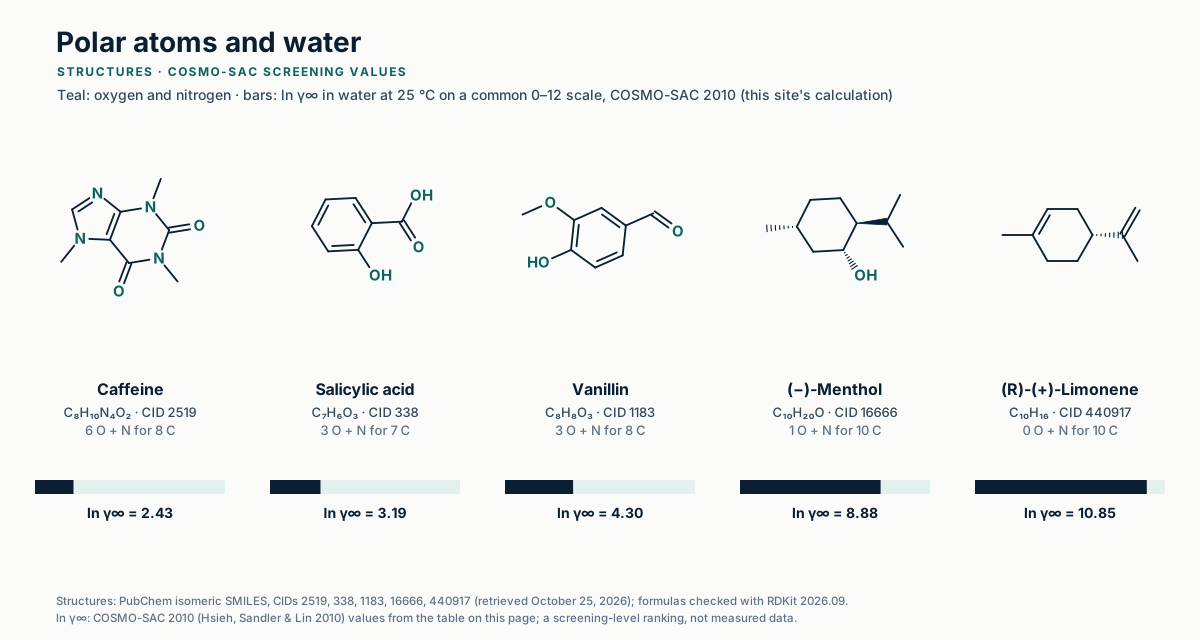
| Salicylic acid | The phenol O–H is bonded to the acid's own C=O inside the molecule, so almost all of the donor surface comes from the acid O–H. About 11% of the area passes a threshold. |
| Caffeine | Two C=O oxygens and one ring nitrogen give acceptor patches (14% of the surface). It has no O–H or N–H; its small donor patch (3%) is a ring C–H. |
| Vanillin | The aldehyde oxygen carries most of the acceptor surface. The phenol O–H points at the neighboring methoxy oxygen, leaving a small donor patch (2%). |
| Menthol | One O–H on a large hydrocarbon ring: only about 6% of the surface can form hydrogen bonds. |
| Limonene | A hydrocarbon terpene: no patch comes near either hydrogen-bond threshold. |
Donor and acceptor shares, areas and volumes for every molecule are in the descriptor table under Provenance.
About 62% of water's surface can form hydrogen bonds and none of hexane's can, which is why the model predicts they barely mix.
The σ-profile shows how much of the surface sits at each charge level
Show data: σ-profiles of all 13 molecules (surface area per bin, Ų)
| σ (e/Ų) | Water | Ethanol | Acetone | Ethyl acet. | Hexane | DCM | Chloroform | CCl₄ | Salicylic acid | Caffeine | Vanillin | Menthol | Limonene |
|---|---|---|---|---|---|---|---|---|---|---|---|---|---|
| −0.025 | 0.00 | 0.00 | 0.00 | 0.00 | 0.00 | 0.00 | 0.00 | 0.00 | 0.00 | 0.00 | 0.00 | 0.00 | 0.00 |
| −0.024 | 0.00 | 0.00 | 0.00 | 0.00 | 0.00 | 0.00 | 0.00 | 0.00 | 0.00 | 0.00 | 0.00 | 0.00 | 0.00 |
| −0.023 | 0.00 | 0.00 | 0.00 | 0.00 | 0.00 | 0.00 | 0.00 | 0.00 | 0.00 | 0.00 | 0.00 | 0.00 | 0.00 |
| −0.022 | 0.00 | 0.00 | 0.00 | 0.00 | 0.00 | 0.00 | 0.00 | 0.00 | 0.00 | 0.00 | 0.00 | 0.00 | 0.00 |
| −0.021 | 0.00 | 0.00 | 0.00 | 0.00 | 0.00 | 0.00 | 0.00 | 0.00 | 0.00 | 0.00 | 0.00 | 0.00 | 0.00 |
| −0.020 | 0.00 | 0.00 | 0.00 | 0.00 | 0.00 | 0.00 | 0.00 | 0.00 | 0.00 | 0.00 | 0.00 | 0.00 | 0.00 |
| −0.019 | 0.00 | 0.00 | 0.00 | 0.00 | 0.00 | 0.00 | 0.00 | 0.00 | 0.17 | 0.00 | 0.00 | 0.00 | 0.00 |
| −0.018 | 0.00 | 0.00 | 0.00 | 0.00 | 0.00 | 0.00 | 0.00 | 0.00 | 0.96 | 0.00 | 0.00 | 0.00 | 0.00 |
| −0.017 | 0.00 | 0.00 | 0.00 | 0.00 | 0.00 | 0.00 | 0.00 | 0.00 | 1.09 | 0.00 | 0.00 | 0.00 | 0.00 |
| −0.016 | 0.00 | 0.02 | 0.00 | 0.00 | 0.00 | 0.00 | 0.00 | 0.00 | 0.61 | 0.00 | 0.00 | 0.00 | 0.00 |
| −0.015 | 0.35 | 0.81 | 0.00 | 0.00 | 0.00 | 0.00 | 0.00 | 0.00 | 1.09 | 0.00 | 0.15 | 0.00 | 0.00 |
| −0.014 | 2.73 | 1.14 | 0.00 | 0.00 | 0.00 | 0.00 | 0.00 | 0.00 | 0.54 | 0.00 | 0.65 | 0.38 | 0.00 |
| −0.013 | 2.87 | 1.08 | 0.00 | 0.00 | 0.00 | 0.00 | 0.39 | 0.00 | 0.60 | 0.00 | 0.55 | 0.80 | 0.00 |
| −0.012 | 2.89 | 0.71 | 0.00 | 0.00 | 0.00 | 0.00 | 2.18 | 0.00 | 0.88 | 0.00 | 0.71 | 0.80 | 0.00 |
| −0.011 | 1.68 | 1.03 | 0.00 | 0.00 | 0.00 | 0.00 | 1.65 | 0.00 | 0.75 | 0.00 | 0.66 | 0.79 | 0.00 |
| −0.010 | 1.58 | 0.78 | 0.00 | 0.00 | 0.00 | 1.65 | 1.34 | 0.00 | 0.61 | 2.33 | 0.53 | 0.95 | 0.00 |
| −0.009 | 1.66 | 0.36 | 0.00 | 0.00 | 0.00 | 4.36 | 1.24 | 0.00 | 0.69 | 2.87 | 0.75 | 0.96 | 0.00 |
| −0.008 | 1.19 | 1.60 | 0.00 | 0.00 | 0.00 | 3.56 | 1.26 | 0.00 | 1.19 | 2.64 | 0.66 | 1.15 | 0.00 |
| −0.007 | 0.99 | 0.65 | 2.61 | 0.71 | 0.00 | 4.36 | 1.16 | 0.00 | 3.32 | 3.97 | 4.89 | 1.23 | 0.00 |
| −0.006 | 1.02 | 0.63 | 10.28 | 4.20 | 0.00 | 3.59 | 1.43 | 0.00 | 7.68 | 9.02 | 17.78 | 1.31 | 0.00 |
| −0.005 | 1.36 | 0.97 | 8.57 | 10.63 | 0.00 | 3.53 | 1.23 | 2.61 | 9.07 | 19.26 | 17.01 | 1.08 | 0.00 |
| −0.004 | 0.96 | 3.45 | 10.12 | 16.12 | 0.00 | 1.75 | 1.52 | 6.69 | 9.87 | 24.48 | 16.77 | 2.15 | 5.79 |
| −0.003 | 0.73 | 12.00 | 11.60 | 20.83 | 2.19 | 3.31 | 6.68 | 8.27 | 11.08 | 33.49 | 10.68 | 9.15 | 29.95 |
| −0.002 | 0.46 | 12.99 | 12.32 | 19.14 | 24.74 | 4.37 | 7.88 | 12.08 | 11.50 | 23.21 | 10.29 | 40.64 | 35.90 |
| −0.001 | 0.57 | 12.57 | 13.65 | 15.78 | 41.74 | 5.26 | 9.61 | 15.18 | 10.66 | 15.95 | 10.81 | 46.79 | 33.24 |
| 0.000 | 1.13 | 10.35 | 7.58 | 11.22 | 42.59 | 5.61 | 11.08 | 21.41 | 9.33 | 9.49 | 9.17 | 38.98 | 35.86 |
| 0.001 | 2.04 | 7.57 | 2.11 | 5.09 | 30.63 | 10.98 | 15.53 | 48.64 | 12.68 | 8.84 | 13.79 | 35.59 | 23.51 |
| 0.002 | 0.71 | 2.36 | 0.98 | 3.04 | 17.74 | 6.53 | 31.38 | 23.23 | 14.09 | 5.78 | 14.60 | 18.83 | 10.61 |
| 0.003 | 0.66 | 2.23 | 2.69 | 3.72 | 1.26 | 15.64 | 23.89 | 0.00 | 13.28 | 5.34 | 15.89 | 3.51 | 7.70 |
| 0.004 | 0.45 | 1.04 | 1.62 | 3.18 | 0.00 | 23.39 | 0.00 | 0.00 | 14.00 | 5.04 | 10.94 | 1.76 | 6.21 |
| 0.005 | 1.38 | 0.69 | 0.68 | 2.73 | 0.00 | 2.24 | 0.00 | 0.00 | 5.45 | 4.42 | 3.30 | 1.79 | 6.40 |
| 0.006 | 1.12 | 1.42 | 1.60 | 2.35 | 0.00 | 0.00 | 0.00 | 0.00 | 5.06 | 4.03 | 2.70 | 1.04 | 5.00 |
| 0.007 | 0.71 | 1.80 | 1.04 | 2.62 | 0.00 | 0.00 | 0.00 | 0.00 | 2.57 | 3.52 | 3.53 | 1.38 | 4.03 |
| 0.008 | 0.90 | 0.92 | 2.00 | 2.77 | 0.00 | 0.00 | 0.00 | 0.00 | 3.05 | 4.36 | 3.12 | 1.25 | 0.85 |
| 0.009 | 2.13 | 0.75 | 1.40 | 1.81 | 0.00 | 0.00 | 0.00 | 0.00 | 3.49 | 4.39 | 3.95 | 1.12 | 0.00 |
| 0.010 | 0.65 | 1.69 | 2.40 | 2.33 | 0.00 | 0.00 | 0.00 | 0.00 | 3.48 | 4.25 | 3.47 | 1.08 | 0.00 |
| 0.011 | 0.85 | 1.74 | 3.07 | 3.67 | 0.00 | 0.00 | 0.00 | 0.00 | 2.08 | 4.25 | 3.86 | 1.07 | 0.00 |
| 0.012 | 2.19 | 0.81 | 4.65 | 4.50 | 0.00 | 0.00 | 0.00 | 0.00 | 0.01 | 8.75 | 3.59 | 1.05 | 0.00 |
| 0.013 | 1.50 | 1.83 | 2.69 | 0.72 | 0.00 | 0.00 | 0.00 | 0.00 | 0.00 | 6.19 | 1.20 | 1.35 | 0.00 |
| 0.014 | 1.85 | 2.28 | 0.31 | 0.00 | 0.00 | 0.00 | 0.00 | 0.00 | 0.00 | 0.62 | 0.02 | 1.46 | 0.00 |
| 0.015 | 2.86 | 0.59 | 0.00 | 0.00 | 0.00 | 0.00 | 0.00 | 0.00 | 0.00 | 0.57 | 0.00 | 0.61 | 0.00 |
| 0.016 | 0.92 | 0.00 | 0.00 | 0.00 | 0.00 | 0.00 | 0.00 | 0.00 | 0.00 | 0.00 | 0.00 | 0.00 | 0.00 |
| 0.017 | 0.00 | 0.00 | 0.00 | 0.00 | 0.00 | 0.00 | 0.00 | 0.00 | 0.00 | 0.00 | 0.00 | 0.00 | 0.00 |
| 0.018 | 0.00 | 0.00 | 0.00 | 0.00 | 0.00 | 0.00 | 0.00 | 0.00 | 0.00 | 0.00 | 0.00 | 0.00 | 0.00 |
| 0.019 | 0.00 | 0.00 | 0.00 | 0.00 | 0.00 | 0.00 | 0.00 | 0.00 | 0.00 | 0.00 | 0.00 | 0.00 | 0.00 |
| 0.020 | 0.00 | 0.00 | 0.00 | 0.00 | 0.00 | 0.00 | 0.00 | 0.00 | 0.00 | 0.00 | 0.00 | 0.00 | 0.00 |
| 0.021 | 0.00 | 0.00 | 0.00 | 0.00 | 0.00 | 0.00 | 0.00 | 0.00 | 0.00 | 0.00 | 0.00 | 0.00 | 0.00 |
| 0.022 | 0.00 | 0.00 | 0.00 | 0.00 | 0.00 | 0.00 | 0.00 | 0.00 | 0.00 | 0.00 | 0.00 | 0.00 | 0.00 |
| 0.023 | 0.00 | 0.00 | 0.00 | 0.00 | 0.00 | 0.00 | 0.00 | 0.00 | 0.00 | 0.00 | 0.00 | 0.00 | 0.00 |
| 0.024 | 0.00 | 0.00 | 0.00 | 0.00 | 0.00 | 0.00 | 0.00 | 0.00 | 0.00 | 0.00 | 0.00 | 0.00 | 0.00 |
| 0.025 | 0.00 | 0.00 | 0.00 | 0.00 | 0.00 | 0.00 | 0.00 | 0.00 | 0.00 | 0.00 | 0.00 | 0.00 | 0.00 |
Each column sums to the molecule's surface area. Bin centers in e/Ų; DCM is dichloromethane.
Water's surface sits mostly in the two polar zones, hexane's in one peak at zero; the botanical molecules mix a large nonpolar peak with small polar ones.
The σ-potential shows which part of a molecule's surface a solvent penalizes, and the penalties add up to its activity coefficient
[ln ΓS(σ) − ln Γi(σ)]
ln γ∞ = ln γres + ln γcomb
Method, assumptions and limits
- What it calculates
- For one botanical molecule infinitely dilute in one pure solvent at 298.15 K, the term each σ bin adds to the residual part of ln γ∞, the three zone sums, the Staverman–Guggenheim combinatorial part and their total.
- Equations
- Segment activity coefficients of the pure liquid S: ln ΓS(σm) = −ln Σn pS(σn) ΓS(σn) exp(−ΔW(σm, σn)/RT), with pS the normalized profile; the same for the pure solute i. Each bar is pi(σ)[ln ΓS(σ) − ln Γi(σ)]/aeff, with pi in Ų. In the 2010 version the sum also runs over three segment types (non-hydrogen-bonding, O–H, other polar); the bar shows their total at each σ. Combinatorial part: Staverman–Guggenheim term with q = A/79.53 Ų, r = V/66.69 ų, z = 10, at infinite dilution.
- Variables and units
- σ in e/Ų; aeff = 7.5 Ų (2002) or 7.25 Ų (2010); ln Γ and ln γ dimensionless; A and V from the archived surfaces.
- Assumptions
- One conformer per molecule, the archived σ-profiles and both published constant sets exactly as listed under Provenance. Zones use the COSMO-SAC hydrogen-bond threshold 0.0084 e/Ų. In the top panel, 2010 O–H and other-polar curves are drawn only where |σ| > 0.005 e/Ų, where hydrogen-bonding segments occur.
- Valid range
- The 5 botanical molecules and 8 solvents computed here, 25 °C, infinite dilution.
- What it does not establish
- It explains the model's number; it does not make the number right. Solubility also needs the solid's melting properties, and the measured checks are in the next section.
- References
- Lin & Sandler 2002; Hsieh, Sandler & Lin 2010; Mullins et al. 2006; Bell et al. 2020; Klamt 2005 (σ-potential concept in COSMO-RS).
- Verification
- The 80 totals (40 pairs × 2 versions) reproduce the archived ln γ∞ within 5.4 × 10⁻⁶. An independent Python script recomputes the readouts from the archived surfaces for 8 cases (tests/numerics/comp-quantum.json).
Water rejects caffeine (ln γ∞ 2.43); the largest single term comes from its nonpolar surface (10.35).
Show data: contributions for all 40 pairs (2010) and the solvent σ-potentials (2002)
| Solute | Solvent | Donor surface (σ < −0.0084) | Nonpolar surface | Acceptor surface (σ > +0.0084) | Residual | Combinatorial | ln γ∞ |
|---|---|---|---|---|---|---|---|
| Salicylic acid | Water | −1.66 | 7.21 | −0.47 | 5.08 | −1.89 | 3.19 |
| Salicylic acid | Ethanol | −2.37 | 0.46 | 0.80 | −1.12 | −0.20 | −1.32 |
| Salicylic acid | Acetone | −1.99 | −0.81 | 0.71 | −2.08 | −0.09 | −2.17 |
| Salicylic acid | Ethyl acetate | −1.53 | −0.83 | 0.93 | −1.43 | 0.02 | −1.40 |
| Salicylic acid | n-Hexane | 3.08 | 0.10 | 1.56 | 4.74 | 0.03 | 4.77 |
| Salicylic acid | Dichloromethane | 2.24 | −0.57 | 0.84 | 2.52 | −0.13 | 2.39 |
| Salicylic acid | Chloroform | 2.59 | −0.64 | 0.82 | 2.77 | −0.04 | 2.73 |
| Salicylic acid | CCl₄ | 2.94 | −0.06 | 1.49 | 4.37 | −0.01 | 4.36 |
| Caffeine | Water | 0.36 | 10.35 | −5.10 | 5.61 | −3.18 | 2.43 |
| Caffeine | Ethanol | 0.17 | 0.77 | −0.14 | 0.80 | −0.56 | 0.25 |
| Caffeine | Acetone | 0.01 | −0.11 | 0.10 | −0.00 | −0.34 | −0.34 |
| Caffeine | Ethyl acetate | 0.04 | −0.69 | 0.89 | 0.24 | −0.08 | 0.17 |
| Caffeine | n-Hexane | 0.49 | −0.18 | 3.29 | 3.61 | −0.00 | 3.61 |
| Caffeine | Dichloromethane | 0.18 | −1.54 | 0.18 | −1.18 | −0.41 | −1.59 |
| Caffeine | Chloroform | 0.30 | −1.43 | −0.12 | −1.25 | −0.23 | −1.48 |
| Caffeine | CCl₄ | 0.44 | −0.52 | 2.95 | 2.87 | −0.13 | 2.75 |
| Vanillin | Water | −0.07 | 9.05 | −2.20 | 6.77 | −2.47 | 4.30 |
| Vanillin | Ethanol | −0.41 | 0.88 | 0.25 | 0.72 | −0.37 | 0.35 |
| Vanillin | Acetone | −0.38 | −0.38 | 0.18 | −0.57 | −0.21 | −0.78 |
| Vanillin | Ethyl acetate | −0.20 | −0.60 | 0.59 | −0.21 | −0.03 | −0.24 |
| Vanillin | n-Hexane | 1.36 | 0.43 | 1.80 | 3.59 | 0.01 | 3.60 |
| Vanillin | Dichloromethane | 1.04 | −0.68 | 0.32 | 0.68 | −0.26 | 0.42 |
| Vanillin | Chloroform | 1.17 | −0.61 | 0.22 | 0.78 | −0.12 | 0.66 |
| Vanillin | CCl₄ | 1.31 | 0.17 | 1.64 | 3.12 | −0.05 | 3.06 |
| Menthol | Water | 0.08 | 14.18 | −2.13 | 12.14 | −3.26 | 8.88 |
| Menthol | Ethanol | −0.31 | 1.76 | −0.48 | 0.96 | −0.59 | 0.38 |
| Menthol | Acetone | −0.30 | 0.86 | 0.21 | 0.77 | −0.36 | 0.40 |
| Menthol | Ethyl acetate | −0.11 | 0.34 | 0.43 | 0.66 | −0.09 | 0.57 |
| Menthol | n-Hexane | 1.50 | −0.39 | 1.12 | 2.23 | −0.01 | 2.22 |
| Menthol | Dichloromethane | 1.14 | 0.18 | 0.19 | 1.52 | −0.44 | 1.08 |
| Menthol | Chloroform | 1.29 | −0.39 | 0.08 | 0.98 | −0.24 | 0.73 |
| Menthol | CCl₄ | 1.44 | −0.45 | 1.01 | 2.00 | −0.14 | 1.87 |
| Limonene | Water | 0.00 | 13.77 | −0.00 | 13.77 | −2.92 | 10.85 |
| Limonene | Ethanol | 0.00 | 2.09 | −0.00 | 2.09 | −0.50 | 1.60 |
| Limonene | Acetone | 0.00 | 1.01 | −0.00 | 1.01 | −0.30 | 0.71 |
| Limonene | Ethyl acetate | 0.00 | 0.58 | −0.00 | 0.57 | −0.07 | 0.51 |
| Limonene | n-Hexane | 0.00 | 0.13 | 0.00 | 0.13 | −0.00 | 0.12 |
| Limonene | Dichloromethane | 0.00 | 0.28 | −0.00 | 0.28 | −0.36 | −0.08 |
| Limonene | Chloroform | 0.00 | −0.20 | −0.00 | −0.20 | −0.19 | −0.39 |
| Limonene | CCl₄ | 0.00 | 0.03 | 0.00 | 0.03 | −0.10 | −0.07 |
| σ (e/Ų) | Water | Ethanol | Acetone | Ethyl acetate | n-Hexane | Dichloromethane | Chloroform | CCl₄ |
|---|---|---|---|---|---|---|---|---|
| −0.025 | −10.84 | −9.38 | −7.84 | −5.56 | 8.41 | 6.87 | 7.56 | 8.20 |
| −0.023 | −9.22 | −8.12 | −6.92 | −4.94 | 7.13 | 5.73 | 6.35 | 6.93 |
| −0.021 | −7.53 | −6.79 | −5.93 | −4.24 | 5.95 | 4.71 | 5.25 | 5.77 |
| −0.019 | −5.79 | −5.40 | −4.88 | −3.48 | 4.88 | 3.79 | 4.26 | 4.72 |
| −0.017 | −4.03 | −3.96 | −3.78 | −2.64 | 3.92 | 2.97 | 3.38 | 3.77 |
| −0.015 | −2.29 | −2.50 | −2.64 | −1.76 | 3.06 | 2.26 | 2.60 | 2.93 |
| −0.013 | −0.70 | −1.09 | −1.49 | −0.86 | 2.30 | 1.66 | 1.92 | 2.20 |
| −0.011 | 0.42 | 0.07 | −0.40 | −0.04 | 1.66 | 1.15 | 1.36 | 1.58 |
| −0.009 | 0.87 | 0.64 | 0.41 | 0.48 | 1.12 | 0.75 | 0.89 | 1.06 |
| −0.007 | 0.81 | 0.54 | 0.48 | 0.45 | 0.68 | 0.44 | 0.53 | 0.64 |
| −0.005 | 0.71 | 0.36 | 0.36 | 0.31 | 0.36 | 0.23 | 0.27 | 0.33 |
| −0.003 | 0.62 | 0.21 | 0.23 | 0.18 | 0.13 | 0.10 | 0.10 | 0.12 |
| −0.001 | 0.55 | 0.11 | 0.11 | 0.08 | 0.02 | 0.05 | 0.02 | 0.02 |
| +0.001 | 0.48 | 0.08 | 0.04 | 0.03 | 0.01 | 0.06 | 0.03 | 0.01 |
| +0.003 | 0.42 | 0.13 | 0.03 | 0.05 | 0.10 | 0.13 | 0.11 | 0.11 |
| +0.005 | 0.39 | 0.25 | 0.09 | 0.16 | 0.31 | 0.25 | 0.25 | 0.31 |
| +0.007 | 0.39 | 0.45 | 0.24 | 0.35 | 0.61 | 0.41 | 0.42 | 0.60 |
| +0.009 | 0.33 | 0.72 | 0.49 | 0.63 | 1.03 | 0.60 | 0.52 | 1.00 |
| +0.011 | −0.17 | 0.87 | 0.83 | 1.02 | 1.55 | 0.75 | 0.09 | 1.49 |
| +0.013 | −1.04 | 0.56 | 1.26 | 1.50 | 2.18 | 0.90 | −0.70 | 2.08 |
| +0.015 | −2.16 | −0.45 | 1.80 | 2.08 | 2.91 | 1.05 | −1.60 | 2.76 |
| +0.017 | −3.39 | −1.83 | 2.43 | 2.76 | 3.75 | 1.20 | −2.50 | 3.54 |
| +0.019 | −4.64 | −3.31 | 3.17 | 3.54 | 4.70 | 1.39 | −3.36 | 4.43 |
| +0.021 | −5.87 | −4.77 | 4.01 | 4.42 | 5.76 | 1.62 | −4.14 | 5.40 |
| +0.023 | −7.07 | −6.19 | 4.95 | 5.41 | 6.92 | 1.93 | −4.85 | 6.48 |
| +0.025 | −8.22 | −7.55 | 5.99 | 6.50 | 8.19 | 2.31 | −5.48 | 7.66 |
Water pushes out all five botanical molecules, while three ICH Class 3 solvents keep every one below ln γ∞ = 2
Show data: ln γ∞ for every pair, both model versions
COSMO-SAC 2010
| Solute | Water | Ethanol | Acetone | Ethyl acet. | Hexane | DCM | Chloroform | CCl₄ |
|---|---|---|---|---|---|---|---|---|
| Salicylic acid | 3.19 | −1.32 | −2.17 | −1.40 | 4.77 | 2.39 | 2.73 | 4.36 |
| Caffeine | 2.43 | 0.25 | −0.34 | 0.17 | 3.61 | −1.59 | −1.48 | 2.75 |
| Vanillin | 4.30 | 0.35 | −0.78 | −0.24 | 3.60 | 0.42 | 0.66 | 3.06 |
| Menthol | 8.88 | 0.38 | 0.40 | 0.57 | 2.22 | 1.08 | 0.73 | 1.87 |
| Limonene | 10.85 | 1.60 | 0.71 | 0.51 | 0.12 | −0.08 | −0.39 | −0.07 |
COSMO-SAC 2002
| Solute | Water | Ethanol | Acetone | Ethyl acet. | Hexane | DCM | Chloroform | CCl₄ |
|---|---|---|---|---|---|---|---|---|
| Salicylic acid | 1.56 | −2.24 | −3.58 | −2.52 | 3.20 | 0.93 | 0.92 | 2.85 |
| Caffeine | 1.09 | −0.54 | −0.35 | 0.22 | 3.63 | −1.93 | −5.10 | 2.87 |
| Vanillin | 3.61 | 0.27 | −0.82 | −0.25 | 3.01 | −0.24 | −1.22 | 2.53 |
| Menthol | 7.56 | 0.31 | 0.14 | 0.32 | 1.47 | 0.14 | −1.29 | 1.15 |
| Limonene | 9.18 | 1.34 | 0.69 | 0.48 | 0.11 | −0.09 | −0.36 | −0.07 |
Natural logarithm of the infinite-dilution activity coefficient of the solute (row) in the solvent (column) at 298.15 K. γ∞ = eln γ∞; ln γ∞ = 2 means γ∞ ≈ 7.4.
Water pushes out every molecule here (ln γ∞ above 2 in each case), most strongly the two terpenes (ln γ∞ near 9 for menthol and 11 for limonene). Acetone and ethyl acetate suit salicylic acid and vanillin best; caffeine prefers dichloromethane and chloroform; limonene mixes almost ideally with hexane and the chlorinated solvents (ln γ∞ near zero).
In both versions water pushes out every molecule here, the terpenes menthol and limonene most strongly.
Data table: ICH Q3C class and ln γ∞ for each solvent
| Solvent | ICH Q3C | Limit (ppm, Option 1) | Salicylic acid | Caffeine | Vanillin | Menthol | Limonene |
|---|---|---|---|---|---|---|---|
| Water | Not a Q3C solvent | not applicable | 3.19 | 2.43 | 4.30 | 8.88 | 10.85 |
| Ethanol | Class 3 | 5000 | −1.32 | 0.25 | 0.35 | 0.38 | 1.60 |
| Acetone | Class 3 | 5000 | −2.17 | −0.34 | −0.78 | 0.40 | 0.71 |
| Ethyl acetate | Class 3 | 5000 | −1.40 | 0.17 | −0.24 | 0.57 | 0.51 |
| n-Hexane | Class 2 | 290 | 4.77 | 3.61 | 3.60 | 2.22 | 0.12 |
| Dichloromethane | Class 2 | 600 | 2.39 | −1.59 | 0.42 | 1.08 | −0.08 |
| Chloroform | Class 2 | 60 | 2.73 | −1.48 | 0.66 | 0.73 | −0.39 |
| CCl₄ | Class 1 | 4 | 4.36 | 2.75 | 3.06 | 1.87 | −0.07 |
In the 2010 version only ethanol, acetone and ethyl acetate stay below ln γ∞ = 2 for all five molecules, and all three are ICH Class 3.
Show data: salicylic acid and caffeine solubility
Salicylic acid, 25 °C (mole fraction x)
| Solvent | Measured, mass fraction | Measured, x | COSMO-SAC 2010, x | COSMO-SAC 2002, x | 2010 ÷ measured | 2002 ÷ measured |
|---|---|---|---|---|---|---|
| Water | 0.00220 | 2.87 × 10⁻⁴ | 2.02 × 10⁻³ | 0.0129 | 7.02 | 44.98 |
| Ethanol | 0.3254 | 0.139 | 0.124 | 0.215 | 0.90 | 1.55 |
| Ethyl acetate | 0.2008 | 0.138 | 0.137 | 0.247 | 0.99 | 1.79 |
| Carbon tetrachloride | 0.00299 | 3.33 × 10⁻³ | 7.62 × 10⁻⁴ | 3.23 × 10⁻³ | 0.23 | 0.97 |
| Acetone | not measured | — | 0.195 | 0.339 | — | — |
| n-Hexane | not measured | — | 4.73 × 10⁻⁴ | 2.17 × 10⁻³ | — | — |
| Dichloromethane | not measured | — | 7.78 × 10⁻³ | 0.0246 | — | — |
| Chloroform | not measured | — | 5.20 × 10⁻³ | 0.0234 | — | — |
Caffeine, 25 °C (predicted mole fraction x)
| Solvent | COSMO-SAC 2010, x | Rank (2010) | COSMO-SAC 2002, x | Rank (2002) |
|---|---|---|---|---|
| Dichloromethane | 0.0804 | 1 | 0.0929 | 2 |
| Chloroform | 0.0688 | 2 | 0.165 | 1 |
| Acetone | 0.0345 | 3 | 0.0349 | 4 |
| Ethyl acetate | 0.0219 | 4 | 0.0208 | 5 |
| Ethanol | 0.0197 | 5 | 0.0386 | 3 |
| Water | 2.40 × 10⁻³ | 6 | 0.0103 | 6 |
| Carbon tetrachloride | 1.67 × 10⁻³ | 7 | 1.49 × 10⁻³ | 7 |
| n-Hexane | 6.97 × 10⁻⁴ | 8 | 6.87 × 10⁻⁴ | 8 |
Ideal solubility (no solvent effect) at 25 °C: salicylic acid x = 0.0464, caffeine x = 0.0254. A ratio above 1 means the model predicts more dissolves than was measured.
For salicylic acid, the 2010 version lands within about 10% of the measured value in ethanol and ethyl acetate, but it is 7 times too high in water and 4 times too low in carbon tetrachloride. The 2002 version is 45 times too high in water. Both versions rank chloroform and dichloromethane first for caffeine, as the measured study found. Good enough to rank solvents; not a substitute for measuring.
For salicylic acid the 2010 version lands within about 10% of measured solubility in ethanol and ethyl acetate but is 7 times too high in water.
Explanation, details and sources
We coded two published versions of the COSMO-SAC model, the 2002 original and its 2010 revision, and ran both on our own surfaces at 25 °C. The model scores every surface contact, then gives each molecule an activity coefficient γ. Below 1, the solvent welcomes it; far above 1, the solvent pushes it out. Values here are at infinite dilution (γ∞), a single solute molecule in pure solvent.
A single surface descriptor captures part of a solvent ranking; the full model is needed for the rest
1 = same order
0 = unrelated
Method, assumptions and limits
- What it calculates
- How closely one descriptor, computed from the σ-profiles of the solute and solvent, reproduces the order in which COSMO-SAC ranks eight solvents for one botanical molecule at 25 °C.
- Equations
- Descriptors as defined above the explorer. Rank agreement ρ = Spearman's rank correlation between the descriptor ranking (most favorable first: smallest mismatch, or largest complementarity) and the COSMO-SAC ranking (lowest ln γ∞ first), with average ranks for ties.
- Variables and units
- σ in e/Ų; p(σ) in Ų; M2/A in e²/Å⁴; Mdon and Macc in e; complementarity in e²; ln γ∞ dimensionless.
- Assumptions
- One conformer per molecule; profiles and ln γ∞ exactly as in the tables on this page; σhb = 0.0084 e/Ų. Both rankings are computed from our σ-profiles; neither is a measurement. With eight solvents, swapping two neighbors in one ranking changes ρ by 0.024. Descriptors ignore temperature, molecular size and competition between patches; COSMO-SAC includes them.
- Valid range
- The five botanical molecules and eight solvents computed here, at 298.15 K. ρ is not defined when a descriptor has the same value for every solvent (limonene has no hydrogen-bonding surface, so its complementarity is zero everywhere).
- What it does not establish
- It does not test either ranking against measurements, and it does not show that any descriptor predicts solubility. Solubility also depends on the solid's melting properties and on concentration.
- References
- Klamt A. COSMO-RS: From Quantum Chemistry to Fluid Phase Thermodynamics and Drug Design. Elsevier; 2005. Lin & Sandler 2002; Hsieh, Sandler & Lin 2010; Bell et al. 2020.
- Verification
- An independent Python script recomputes the descriptors from the archived full-precision profiles and the Spearman coefficients with SciPy; the page values are checked against it for 8 cases (tests/numerics/insights-quantum-chemistry.json).
Polarity mismatch alone nearly reproduces the model's solvent order for vanillin (ρ = 1.00) and salicylic acid (0.90), but not for caffeine (0.50) or menthol (−0.10).
Show data: rank agreement for every molecule, descriptor and model version
Polarity mismatch orders the eight solvents almost as COSMO-SAC 2010 does for vanillin (ρ = 1.00), salicylic acid (0.90) and limonene (0.81), but not for caffeine (0.50) or menthol (−0.10). Hydrogen-bond complementarity agrees less (ρ from 0.06 to 0.59; not defined for limonene, which has no hydrogen-bonding surface). Water offers caffeine the most hydrogen-bond partners (4.6 × 10⁻³ e²), yet the model predicts it rejects caffeine (ln γ∞ = 2.4): in the model, water's donor and acceptor patches pair with each other more favorably than with caffeine's.
| Botanical molecule | Polarity mismatch, 2010 | H-bond complementarity, 2010 | Polarity mismatch, 2002 | H-bond complementarity, 2002 |
|---|---|---|---|---|
| Salicylic acid | 0.90 | 0.59 | 0.88 | 0.61 |
| Caffeine | 0.50 | 0.37 | 0.55 | 0.56 |
| Vanillin | 1.00 | 0.06 | 0.74 | 0.08 |
| Menthol | −0.10 | 0.30 | 0.48 | 0.11 |
| Limonene | 0.81 | not defined | 0.81 | not defined |
Polarity mismatch, 10⁻⁵ e²/Å⁴ (botanical molecule against each solvent)
| Botanical molecule | Water | Ethanol | Acetone | Ethyl acet. | Hexane | DCM | Chloroform | CCl₄ |
|---|---|---|---|---|---|---|---|---|
| Salicylic acid | 7.73 | 0.56 | 0.26 | 0.58 | 2.70 | 1.01 | 1.60 | 2.55 |
| Caffeine | 7.30 | 0.14 | 0.16 | 1.00 | 3.13 | 1.43 | 2.03 | 2.97 |
| Vanillin | 7.85 | 0.68 | 0.39 | 0.46 | 2.58 | 0.89 | 1.48 | 2.42 |
| Menthol | 9.39 | 2.22 | 1.93 | 1.08 | 1.04 | 0.66 | 0.06 | 0.88 |
| Limonene | 9.93 | 2.77 | 2.47 | 1.63 | 0.50 | 1.20 | 0.60 | 0.34 |
Hydrogen-bond complementarity, 10⁻³ e²
| Botanical molecule | Water | Ethanol | Acetone | Ethyl acet. | Hexane | DCM | Chloroform | CCl₄ |
|---|---|---|---|---|---|---|---|---|
| Salicylic acid | 3.12 | 1.90 | 1.94 | 1.51 | 0.00 | 0.07 | 0.22 | 0.00 |
| Caffeine | 4.61 | 2.26 | 0.24 | 0.19 | 0.00 | 0.46 | 1.48 | 0.00 |
| Vanillin | 2.50 | 1.31 | 0.55 | 0.43 | 0.00 | 0.19 | 0.61 | 0.00 |
| Menthol | 2.06 | 1.10 | 0.56 | 0.44 | 0.00 | 0.14 | 0.46 | 0.00 |
| Limonene | 0.00 | 0.00 | 0.00 | 0.00 | 0.00 | 0.00 | 0.00 | 0.00 |
Explanation, details and sources
Formulators often reason with one number, such as polarity. Here two such descriptors, computed from the same σ-profiles, are compared with the full COSMO-SAC ranking of eight solvents for each botanical molecule. Both sides of this comparison are computed; the check against measurement is the salicylic acid chart above.
p(σ) is the area in each σ bin of a σ-profile; σhb = 0.0084 e/Ų, the COSMO-SAC hydrogen-bond threshold.
Every number on this page can be regenerated from the archived scripts
Text version: re-run result and calculation settings
Reproducibility check. On October 22, 2026, all 13 surface calculations and the COSMO-SAC screen were re-run from the archived scripts in a fresh copy of the folder. Geometries were identical, total energies agreed within 4 × 10⁻¹² Eh, σ-profiles within 2 × 10⁻¹⁰ Ų per bin, and all 123 screening results within a relative 4 × 10⁻¹¹.
Calculation settings
- Structures
- 13 molecules entered as SMILES (table below). Stereocenters as written: (1R,2S,5R)-menthol and (R)-limonene, by RDKit's CIP labeling.
- Conformers
- RDKit ETKDGv3 distance-geometry embedding, 30 conformers per molecule (random seed 42; one for water), each minimized with MMFF94 (up to 2,000 iterations; all converged). The lowest-energy conformer is used. No quantum-mechanical geometry optimization.
- Electronic structure
- PySCF 2.14.0, restricted Kohn–Sham DFT, BP86 functional (Becke 1988 exchange, Perdew 1986 correlation), def2-SVP basis with density fitting, integration grid level 2.
- Convergence
- Gas-phase SCF to PySCF's default energy tolerance of 10⁻⁹ Eh; conductor SCF to 10⁻⁸ Eh, started from the gas-phase density. All 26 SCF runs converged.
- Conductor model
- C-PCM with the dielectric constant set to infinity (the COSMO conductor limit); smooth (SWIG) surface discretization with a 194-point Lebedev grid per atom; radii H 1.30, C 2.00, N 1.83, O 1.72, Cl 2.05 Å (Klamt et al. 1998).
- Surface charge density
- σ = screening charge ÷ segment area, in e/Ų; positive σ faces electron-rich atoms. Cavity volume from the surface by the divergence theorem. Net screening charge near zero (−0.005 to −0.035 e) confirms that the cavity captured almost all of each molecule's field.
- Averaging and σ-profile
- 2002 version: local averaging radius 0.81764 Å, decay factor 1 (Mullins et al. 2006). 2010 version: radius (7.25/π)½ Å, decay factor 3.57, profile split into non-hydrogen-bonding, O–H and other polar parts with Phb(σ) = 1 − exp(−σ²/2σ₀²), σ₀ = 0.007 e/Ų. 51 bins from −0.025 to +0.025 e/Ų, area split linearly between neighboring bins.
- COSMO-SAC 2002 constants
- α′ = 16,466.72 and chb = 85,580 kcal·Å⁴/(mol·e²); σhb = 0.0084 e/Ų; aeff = 7.5 Ų; q₀ = 79.53 Ų, r₀ = 66.69 ų, z = 10.
- COSMO-SAC 2010 constants
- AES = 6,525.69 kcal·Å⁴/(mol·e²), BES = 1.4859 × 10⁸ kcal·Å⁴·K²/(mol·e²); cOH–OH = 4,013.78, cOT–OT = 932.31, cOH–OT = 3,016.43 kcal·Å⁴/(mol·e²); aeff = 7.25 Ų. No dispersion term.
- Source of the constants
- Re-implemented in Python from NIST's open-source COSMO-SAC benchmark code (Bell et al. 2020; github.com/usnistgov/COSMOSAC, commit 1b82456, MIT-style license, copyright 2018 United States Secretary of Commerce, NIST). Every constant above was checked line by line against that code on October 22, 2026. The UD and VT-2005 σ-profile databases distributed with the code were not used: they are licensed for academic, non-commercial use only. Gas constant 0.001987204 kcal/(mol·K) for both versions (NIST truncates it to 0.001987 for the 2002 version, a 0.01% difference).
- Segment activity coefficients
- Solved by damped successive substitution (factor 0.5) to a tolerance of 10⁻¹⁰ in ln Γ.
- Solid–liquid equilibrium
- ln x = −(ΔHfus/R)(1/T − 1/Tm) − ln γ(x, T), solved at the saturated composition; heat-capacity term and solid–solid transitions neglected. Fusion data from the NIST Chemistry WebBook: salicylic acid 24.6 kJ/mol at 431.8 K, caffeine 21.9 kJ/mol at 510.2 K.
- Software and hardware
- Versions used for the October 22, 2026 re-run, which reproduced the archived results: Python 3.13, NumPy 2.5, SciPy 1.18, RDKit 2026.09.1, PySCF 2.14.0; two CPU threads on a cloud machine. Wall time per molecule 2 seconds (water) to 4.4 minutes (menthol) in the archived run.
Structures table: SMILES, InChIKey, formula, molar mass
| Molecule | Role | SMILES | InChIKey | Formula | Molar mass (g/mol) | Stereochemistry |
|---|---|---|---|---|---|---|
| Water | solvent | O | XLYOFNOQVPJJNP-UHFFFAOYSA-N | H2O | 18.02 | none |
| Ethanol | solvent | CCO | LFQSCWFLJHTTHZ-UHFFFAOYSA-N | C2H6O | 46.07 | none |
| Acetone | solvent | CC(C)=O | CSCPPACGZOOCGX-UHFFFAOYSA-N | C3H6O | 58.08 | none |
| Ethyl acetate | solvent | CCOC(C)=O | XEKOWRVHYACXOJ-UHFFFAOYSA-N | C4H8O2 | 88.11 | none |
| n-Hexane | solvent | CCCCCC | VLKZOEOYAKHREP-UHFFFAOYSA-N | C6H14 | 86.18 | none |
| Dichloromethane | solvent | ClCCl | YMWUJEATGCHHMB-UHFFFAOYSA-N | CH2Cl2 | 84.93 | none |
| Chloroform | solvent | ClC(Cl)Cl | HEDRZPFGACZZDS-UHFFFAOYSA-N | CHCl3 | 119.38 | none |
| Carbon tetrachloride | solvent | ClC(Cl)(Cl)Cl | VZGDMQKNWNREIO-UHFFFAOYSA-N | CCl4 | 153.82 | none |
| Salicylic acid | solute | OC(=O)c1ccccc1O | YGSDEFSMJLZEOE-UHFFFAOYSA-N | C7H6O3 | 138.12 | none |
| Caffeine | solute | Cn1cnc2c1c(=O)n(C)c(=O)n2C | RYYVLZVUVIJVGH-UHFFFAOYSA-N | C8H10N4O2 | 194.19 | none |
| Vanillin | solute | COc1cc(C=O)ccc1O | MWOOGOJBHIARFG-UHFFFAOYSA-N | C8H8O3 | 152.15 | none |
| Menthol | solute | CC(C)[C@@H]1CC[C@@H](C)C[C@H]1O | NOOLISFMXDJSKH-KXUCPTDWSA-N | C10H20O | 156.27 | (1R,2S,5R) |
| Limonene | solute | CC1=CC[C@@H](CC1)C(C)=C | XMGQYMWWDOXHJM-JTQLQIEISA-N | C10H16 | 136.24 | (4R) |
Run log: atoms, segments, area, volume, energies, wall time
| Molecule | Atoms | Surface segments | Area (Ų) | Volume (ų) | Net screening charge (e) | Gas-phase energy (Eh) | Energy in conductor (Eh) | Difference (kcal/mol) | SCF converged | Wall time |
|---|---|---|---|---|---|---|---|---|---|---|
| Water | 3 | 374 | 43.08 | 25.45 | −0.0050 | −76.359025 | −76.369336 | −6.47 | yes | 2 s |
| Ethanol | 9 | 878 | 88.86 | 67.73 | −0.0173 | −154.916340 | −154.923572 | −4.54 | yes | 15 s |
| Acetone | 10 | 973 | 103.98 | 82.98 | −0.0173 | −193.006850 | −193.015422 | −5.38 | yes | 21 s |
| Ethyl acetate | 14 | 1,300 | 137.18 | 114.28 | −0.0204 | −307.475165 | −307.483346 | −5.13 | yes | 43 s |
| n-Hexane | 20 | 1,814 | 160.90 | 137.41 | −0.0315 | −236.889976 | −236.890770 | −0.50 | yes | 1.0 min |
| Dichloromethane | 5 | 565 | 100.12 | 80.90 | −0.0089 | −959.465849 | −959.470663 | −3.02 | yes | 6 s |
| Chloroform | 5 | 578 | 119.44 | 101.56 | −0.0086 | −1,418.957831 | −1,418.961715 | −2.44 | yes | 12 s |
| Carbon tetrachloride | 5 | 585 | 138.10 | 122.50 | −0.0088 | −1,878.444459 | −1,878.445803 | −0.84 | yes | 12 s |
| Salicylic acid | 16 | 1,373 | 160.93 | 149.76 | −0.0179 | −495.705424 | −495.716951 | −7.23 | yes | 1.6 min |
| Caffeine | 24 | 1,953 | 217.06 | 208.77 | −0.0215 | −679.896051 | −679.914682 | −11.69 | yes | 4.1 min |
| Vanillin | 19 | 1,609 | 186.01 | 172.75 | −0.0206 | −534.934657 | −534.948463 | −8.66 | yes | 2.0 min |
| Menthol | 31 | 2,514 | 220.04 | 210.69 | −0.0348 | −467.982913 | −467.989958 | −4.42 | yes | 4.4 min |
| Limonene | 26 | 2,171 | 205.03 | 192.59 | −0.0324 | −390.372541 | −390.376017 | −2.18 | yes | 3.2 min |
Energies are total electronic energies. The difference is the energy change on entering a perfect conductor; it is not a solvation free energy in any real solvent. Wall times are from the archived run and vary with machine load.
Show data: surface descriptors for all 13 molecules
| Molecule | Donor area (%) | Acceptor area (%) | M2 (10⁻³ e²/Ų) | M2/A (10⁻⁵ e²/Å⁴) | Mdon (10⁻³ e) | Macc (10⁻³ e) |
|---|---|---|---|---|---|---|
| Water | 32.5 | 29.9 | 4.57 | 10.60 | 49.09 | 55.52 |
| Ethanol | 6.7 | 11.0 | 3.05 | 3.43 | 23.51 | 35.69 |
| Acetone | 0.0 | 13.9 | 3.26 | 3.14 | 0.00 | 43.53 |
| Ethyl acetate | 0.0 | 10.1 | 3.14 | 2.29 | 0.00 | 33.89 |
| n-Hexane | 0.0 | 0.0 | 0.27 | 0.17 | 0.00 | 0.00 |
| Dichloromethane | 6.4 | 0.0 | 1.87 | 1.86 | 5.25 | 0.00 |
| Chloroform | 5.6 | 0.0 | 1.52 | 1.27 | 16.84 | 0.00 |
| Carbon tetrachloride | 0.0 | 0.0 | 0.45 | 0.33 | 0.00 | 0.00 |
| Salicylic acid | 5.1 | 6.0 | 4.62 | 2.87 | 44.54 | 13.10 |
| Caffeine | 2.5 | 13.8 | 7.15 | 3.30 | 5.46 | 87.65 |
| Vanillin | 2.2 | 9.0 | 5.11 | 2.75 | 12.73 | 36.53 |
| Menthol | 2.1 | 3.7 | 2.66 | 1.21 | 12.86 | 27.37 |
| Limonene | 0.0 | 0.0 | 1.37 | 0.67 | 0.00 | 0.00 |
Donor and acceptor area: share of the surface with σ below −0.0084 or above +0.0084 e/Ų. Moments as defined in the explorer.
The two model versions disagree by up to a factor of 6.4, a fair measure of screening uncertainty here
Text version of the six limits
No single error bar applies to a COSMO-SAC prediction. The version spread, the misses against measured data and the input ranges give a practical sense of it.
Screening, not proof
COSMO-type predictions usually rank solvents usefully but can miss absolute solubility by a large factor: here 7-fold (2010) and 45-fold (2002) for salicylic acid in water. Decisions still rest on measurements.
Parameters from another setup
The COSMO-SAC constants were fitted to σ-profiles from a different program (DMol3, with the BP functional and DNP basis set). The 2002 and 2010 versions give salicylic acid solubilities up to 6 times apart for the same solvent. Production work would refit or use a matched setup.
One force-field shape per molecule
Geometries are MMFF94 minima, not DFT-optimized, and only the lowest-energy conformer is used. Flexible molecules such as menthol have many shapes; production work would weight several.
The solid matters
Reported heats of fusion for caffeine span 18.3 to 24.8 kJ/mol; that range alone moves predicted solubility by a factor of about 3. Polymorphs and solvates are not modeled.
No dispersion correction
A later variant adds a dispersion term (COSMO-SAC-dsp; Hsieh, Lin & Vrabec 2014); it is not used here. Its effect on these rankings has not been tested.
25 °C, two components
Every number is for one solute in one pure solvent at 298.15 K. Mixed solvents, other temperatures and real extracts with hundreds of compounds were not computed.
Screen many solvents on a computer, then measure only the best few
Text version of the workflow
- Compute onceOne surface calculation per molecule, here 2 seconds to 4.4 minutes on two CPU threads, then reused for every screen.
- Screen widelyRank food-grade solvents and blends for each target compound, with both model versions as a spread.
- Test narrowlyMeasure solubility for the top few candidates, through a qualified external laboratory until EUTECNIQ's own laboratory exists.
- Feed backMeasured values show where the model misses for that compound family and set the next refit.
Explanation, details and sources
Why it mattersSolvent choice drives extraction yield, purity, residual-solvent limits and cost. The founder has published on quantum-chemistry-based property prediction: "New quantum chemistry-based descriptors for better prediction of melting point and viscosity of ionic liquids" (Mehrkesh & Karunanithi, Fluid Phase Equilibria, 2016) Peer-reviewed, and reports using COSMO-RS in prior industrial R&D Founder-reported. Classical phase-equilibrium models are on the Thermodynamics page; extraction methods are under Extraction and purification.
Have a solubility or solvent-selection question?
EUTECNIQ is in formation. We welcome conversations with research partners about computational screening paired with measured data.