Discovery & characterization Regulatory requirementPeer-reviewed methodsAgency and NIST sourcesProposed capability
Development starts with proving what the plant is, what it contains and what could be wrong with it
A botanical needs a confirmed identity, a chemical profile that captures its natural variability, and a screen for adulterants and contaminants before extraction or formulation.
Status. EUTECNIQ has no laboratory. Microscopy, HPTLC, HPLC and LC-MS are planned for Phase I; DNA methods and NMR would go to qualified partners (platform plan). Examples summarize published sources.
8 of 37St John's wort samples adulterated with synthetic dyes; 6 more had non-conforming fingerprints
6chemotypes of one species, Thymus vulgaris, each with a different dominant monoterpene
800 mg/dayEGCG in supplements at or above which trials showed raised serum transaminases
350unique structures recorded for Ginkgo biloba in COCONUT
Frommenwiler et al., J AOAC Int 2016; Thompson et al., J Chem Ecol 2003; EFSA, EFSA J 2018; COCONUT, October 2026 dump. Published results, not EUTECNIQ data.
Identity, variability and contamination are three separate questions
Identity needs more than one method. Macroscopy, microscopy, HPTLC and fingerprints combine; DNA helps with raw material, rarely with extracts.
The plant varies. Chemotype, region, season, harvest and drying change composition, so specifications rest on many lots.
A marker is not an active. A marker shows identity or quantity; it does not prove which constituents cause an effect.
Why it matters
Every later result is only as good as the identity and composition of the starting material
Four published adulterations, each made to pass a check of the expected marker or colorPeer-reviewed studies
Frommenwiler DA, et al. J AOAC Int. 2016;99(5):1204–1212. Wohlmuth H, et al. Phytomedicine. 2014;21(6):912–918. Forsyth JE, et al. Environ Res. 2019;179:108722. Perini M, et al. Antioxidants. 2023;12(2):498. USP ‹2232›. Sample counts are those reported in each study's abstract.Text version of the requirement and the four cases
Identity test for every dietary ingredient21 CFR 111.75. Part 111 requires a supplement manufacturer to “conduct at least one appropriate test or examination to verify the identity of any component that is a dietary ingredient,” unless FDA grants a petition for alternative testing (eCFR, 21 CFR 111.75(a)(1), up to date as of October 20, 2026).
Adulteration is documentedPublished. Published surveys found synthetic dyes in St. John's wort ingredients, free flavonol aglycones and genistein in ginkgo products, and lead chromate pigment added to turmeric. Each case defeated a test that looked only at the expected marker or color.
St. John's wort: of 37 dry extracts, finished products and bulk raw herbs analyzed by the USP HPTLC method with added white-light detection, 8 contained synthetic dyes (0.51–1.36% by weight) and 6 others had flavonoid fingerprints different from the USP specification. Reversed-phase HPTLC separated the polar dyes; scanning densitometry and HPTLC-MS confirmed them (Frommenwiler et al. 2016).
Ginkgo: three of eight retail products contained added free flavonol aglycones, and the same three contained genistein, an isoflavone that does not occur in ginkgo leaf. The pharmacopoeial assays quantify flavonols as aglycones after hydrolysis, so they cannot detect this; assaying aglycones before and after hydrolysis can (Wohlmuth et al. 2014).
Turmeric: lead chromate (PbCrO4), a yellow pigment, has been added to brighten the color; elemental analysis by ICP-MS detects it (Forsyth et al. 2019; USP ‹2232›).
Turmeric: synthetic curcuminoids are hard to detect because they can be blended in natural ratios; carbon-14 analysis is the most effective published test, and stable carbon and hydrogen isotope ratios have been proposed as a cheaper screen (Perini et al. 2023).
Explanation, details and sources
Part 111 requires a supplement manufacturer to “conduct at least one appropriate test or examination to verify the identity of any component that is a dietary ingredient.” A wrong or variable raw material invalidates the stability, safety and clinical work built on it.
EUTECNIQ would deliver identity, fingerprint, contaminant and variability data as one documented package that a buyer, regulatory team or development partner can review. Proposal
Botanical identity
Identity is confirmed by orthogonal methods, each blind to something the others see
Seven identity methods: what each establishes, what it misses and which material it works onCompendial and peer-reviewed sources
USP general chapters ‹563› and ‹203› (USP–NF; titles verified October 22, 2026). Parveen I, et al. Planta Med. 2016;82(14):1225–1235. Raclariu AC, et al. Phytochem Anal. 2018;29(2):123–128. “Phase I” and “Partner” are EUTECNIQ proposals (platform plan), not existing capabilities.Text version: identity methods, what they establish and their limits
Botanical identity methods, what they establish, the materials they work on and their limits
Method
What it establishes
Works on
Limits
Planned
Macroscopic and organoleptic examination
Plant part, gross morphology, foreign matter
Whole and cut raw material
Lost once material is powdered or extracted
Phase I
Microscopy
Diagnostic cells and tissues; some powdered substitutes
Raw material and powders
Needs a trained analyst and authenticated reference; not applicable to extracts
A visual chemical fingerprint compared with a botanical reference material
Raw material, powders, many extracts
Qualitative; closely related species or spiked markers can mimic parts of the pattern
Phase I
HPLC and UHPLC fingerprint
A quantitative profile of the main constituents; marker assays
All forms
Sees only what the detector and method can see; a matching marker can be added
Phase I
LC-MS and GC-MS
Identity of individual constituents; unexpected compounds; volatiles by GC-MS
All forms
Needs reference spectra or standards for confident identification
Phase I
NMR profiling
A whole-extract chemical profile with structural information
Extracts
Lower sensitivity for minor constituents; specialist equipment
Partner
DNA barcoding and metabarcoding
Species identity of raw material; species mixtures in some processed products
Raw material best; processed material with limits
Universal primers are not recommended as the sole identification for processed plant material; extracts may contain little usable DNA, and DNA says nothing about chemical quality
Partner
The published recommendation is a combination: DNA methods with specific primers, chemical analysis, and microscopic and macroscopic examination.
Pharmacopoeial identity tests combine appearance, microscopy and the chemical profile. Processing removes the visual evidence, so extracts depend on chemistry.
Chemotype and variability
The same species can carry a different chemistry, so specifications are built from lot data
One species, six chemistries: the Thymus vulgaris chemotypes and their dominant monoterpenesPeer-reviewed study
Thompson JD, Chalchat JC, Michet A, Linhart YB, Ehlers B. J Chem Ecol. 2003;29(4):859–880 (abstract). Structures drawn from PubChem: thymol CID 6989, carvacrol CID 10364, geraniol CID 637566, α-terpineol CID 17100, linalool CID 6549 (retrieved October 23, 2026); formulas computed with RDKit. The thuyanol chemotype is defined by four monoterpenes, so no single structure is drawn.
A buyer who orders “thyme” without a chemotype has not specified the chemistry.
From source variability to a specification, with retained samples behind every lotProposed sequence
Sources of variation: Goodarzi M, Russell PJ, Vander Heyden Y. Anal Chim Acta. 2013;804:16–28; Li Y, et al. Plant Physiol Biochem. 2020;148:80–89. The sequence is an EUTECNIQ proposal.Text version of the chemotype evidence and the proposed sequence
Chemotypes.Thymus vulgaris has six chemotypes, named after the dominant monoterpene of their essential oil (thymol, carvacrol, geraniol, α-terpineol, linalool and thuyanol), that show marked spatial segregation in nature; many populations hold two or three chemotypes. The phenolic chemotypes (thymol and carvacrol) occur at the end of the biosynthetic chain; their oil carries large amounts of the precursors γ-terpinene and p-cymene, so their dominant monoterpene is a smaller share of the oil than in the non-phenolic geraniol, α-terpineol and linalool chemotypes. The thuyanol chemotype has four characteristic monoterpenes that together make up a smaller share of the oil than the single dominant monoterpene of the other non-phenolic chemotypes. For all chemotypes, the dominant monoterpene's share falls significantly at sites where that chemotype is not the majority type (Thompson et al. 2003).
Growing and processing conditions. The constituents of a herb and their amounts differ with growing conditions such as climate and soil, with the drying process and with the harvest season. Developmental stage and environment both affect secondary metabolites (Goodarzi et al. 2013; Li et al. 2020).
What a specification needsProposal. EUTECNIQ would set ranges from multiple lots across suppliers, regions and seasons, record chemotype and plant part, and retain voucher and reserve samples so that any lot can be re-examined.
A chemotype is a population of one species that makes a distinct set of compounds. Within a chemotype, climate and soil, harvest season, developmental stage and drying still shift the profile.
Chemical fingerprinting
A fingerprint compares the whole profile, so it catches problems a single marker misses
A marker can pass while the profile fails, and chemometrics turns the comparison into a decisionIllustrative chromatograms
Illustrative: each trace is a sum of Gaussian peaks whose positions and heights were chosen for display; it is not a measured chromatogram. Methods and chemometric steps: Goodarzi M, Russell PJ, Vander Heyden Y. Anal Chim Acta. 2013;804:16–28. Wolfender J-L, Marti G, Thomas A, Bertrand S. J Chromatogr A. 2015;1382:136–164.Text version of the profiling methods and chemometric steps
Profiles.
HPLC or UHPLC with UV or diode-array detection: the quantitative workhorse for most constituent classes.
LC-MS: identities of peaks, minor and unexpected constituents.
GC-MS: volatile constituents such as essential-oil terpenes.
HPTLC: a fast visual comparison with a botanical reference material.
Chemometrics.
Similarity analysis: how closely a lot's chromatogram matches the reference.
Principal component analysis and classification models: which lots cluster together, and which do not.
Substantial equivalence: whether a material matches one with a history of use or an earlier commercial lot.
Botanical materials and extracts often contain hundreds of compounds. Chromatographic fingerprinting compares the entire profile with authenticated reference material, not a few peaks.
Markers and actives
Markers are chosen for control, whether or not they cause any effect
Two kinds of marker and three kinds of extract, set by how much of the activity is explainedAgency guidance
EMA HMPC. Reflection paper on markers used for quantitative and qualitative analysis of herbal medicinal products and traditional herbal medicinal products. EMEA/HMPC/253629/2007, 15 July 2008. Extract categories as described by Monagas M, et al. Front Pharmacol. 2022;13:981978, citing EMA (2010). Links from marker type to category: EMA declaration guideline EMA/HMPC/CHMP/CVMP/287539/2005 Rev. 1 (see Purification and standardization).
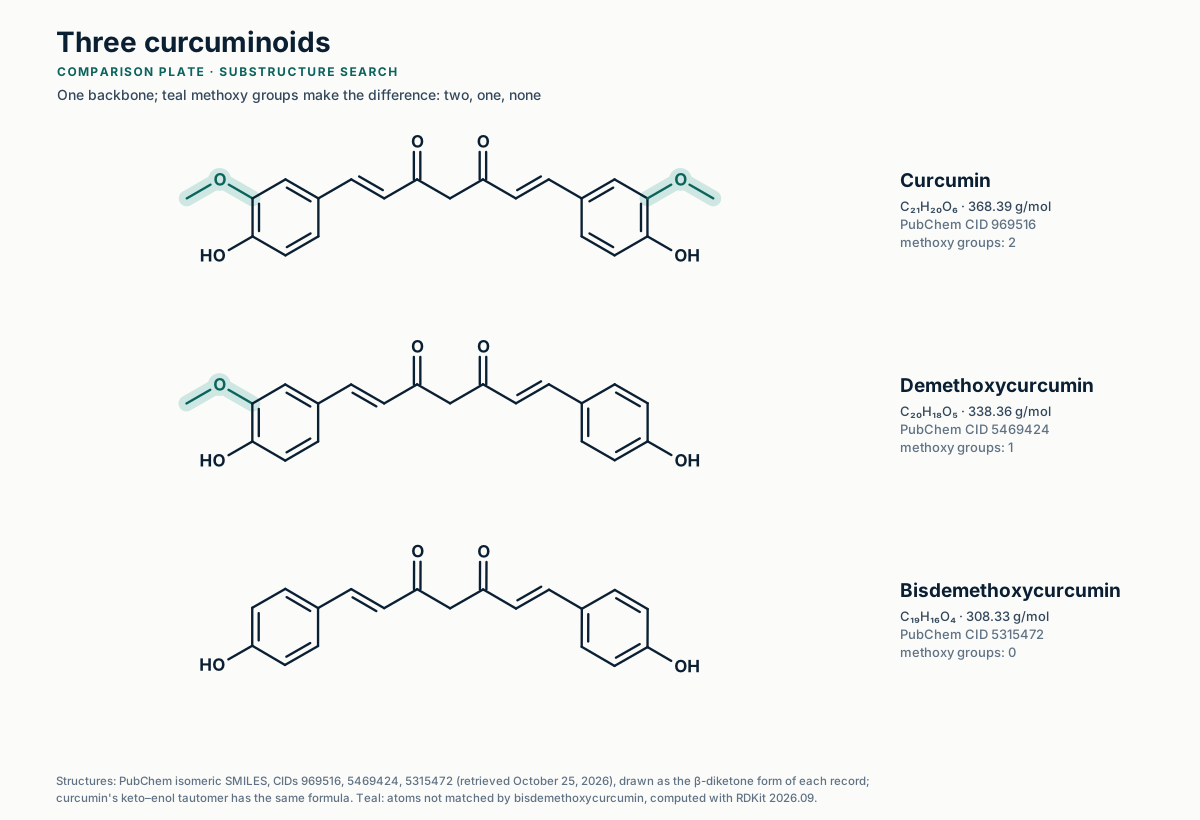
Turmeric's three curcuminoids share one backbone and differ only in methoxy groups: two, one or noneReference structures
Structures: PubChem isomeric SMILES, CIDs 969516, 5469424, 5315472 (retrieved Oct 25, 2026); RDKit 2026.09 2D depiction, β-diketone forms as recorded; highlights from an RDKit substructure search. Generated illustration, EUTECNIQ. Full-size SVGText version of the marker types and extract categories
EMA distinguishes active markers, generally accepted to contribute to activity, from analytical markers, which serve solely for analysis.
Standardized extracts. The identified constituents are understood to fully account for the extract's proven activity, so the extract is adjusted to a defined content.
Quantified extracts. The identified constituents account only partly for the activity; their content is kept within a defined range.
Other extracts. The whole extract is considered the active material; it is defined by its production process and specification.
A marker within specification≠Proof of activity
A higher plant-to-extract ratio≠A stronger or better extract
A passed identity test≠Absence of adulterants or contaminants
Traditional use≠Clinical proof
Explanation, details and sources
The European Medicines Agency defines markers as chemically defined constituents “of interest for control purposes independent of whether they have any therapeutic activity.”
Adulteration & contamination
Each hazard class needs its own test, because none of them shows up in an identity test
Ten hazards and the methods that screen for them: identity methods reach only the first two rowsCompendial and published sources
Methods are those named in the sources below; they are common practice, not requirements. Frameworks: USP general chapters ‹561›, ‹563›, ‹203›, ‹2021›, ‹2022›, ‹2023›, ‹2232› (titles verified on USP–NF, October 22, 2026); 21 CFR 111.75; ICH Q3C.Text version: hazards, published examples, screening methods and frameworks
Adulteration and contamination hazards, examples, screening methods and frameworks
Hazard
Published example or mechanism
How it is screened
Framework
Species substitution and dilution
St. John's wort ingredients with flavonoid fingerprints that did not match the USP specification
HPTLC, HPLC fingerprint, microscopy, DNA for raw material
USP <563>, <203>; 21 CFR 111.75
Spiking with markers or dyes
Free flavonol aglycones and genistein in ginkgo products; synthetic dyes in St. John's wort; synthetic curcuminoids in turmeric
Profiles that separate free from bound forms; reversed-phase HPTLC for dyes; isotope ratios for synthetic origin
Monograph tests plus targeted methods
Toxic pigments
Lead chromate added to turmeric to brighten its color
Elemental analysis (ICP-MS)
USP <2232> Elemental Contaminants in Dietary Supplements
Elemental contaminants
Toxic elements such as lead, taken up from soil or introduced during processing
ICP-MS
USP <2232>
Pesticide residues
Agricultural residues on cultivated and wild-collected material
GC-MS/MS and LC-MS/MS multi-residue methods
USP <561> Articles of Botanical Origin sets limits for residues of 70 pesticides
Mycotoxins
Aflatoxins and ochratoxin A are the mycotoxins most often described in herbal products
LC-MS/MS or immunoaffinity clean-up with HPLC
Specification limits; EU maximum levels where applicable
Polycyclic aromatic hydrocarbons
Formed when combustion gases contact material during heating and drying; environmental pollution; concentrated by extraction
GC-MS or HPLC with fluorescence
Specification limits; market-specific maximum levels
Pyrrolizidine alkaloids
Examined as a possible contaminant of green tea extracts in the USP safety review
LC-MS/MS
Specification limits
Microbial contamination
Bacteria, yeasts and molds from field, storage and handling
Microbial enumeration; tests for specified organisms
Frommenwiler DA, et al. J AOAC Int. 2016;99(5):1204–1212. Wohlmuth H, et al. Phytomedicine. 2014;21(6):912–918. Perini M, et al. Antioxidants. 2023;12(2):498. Forsyth JE, et al. Environ Res. 2019;179:108722. USP general chapters <561>, <2021>, <2022>, <2023>, <2232> (titles verified on USP–NF, October 22, 2026); 70-pesticide figure: Marles R, USP stakeholder forum presentation "Pesticide Residues" (2019). Ałtyn I, Twarużek M. Toxins. 2020;12(3):182. Holland J, Rose M, Petch S. Occurrence of polycyclic aromatic hydrocarbons in herbs, spices, supplements and tea. FERA for the UK Food Standards Agency; 2015. Oketch-Rabah HA, et al. Toxicol Rep. 2020;7:386–402. Analytical methods listed are common practice, not requirements.
Explanation, details and sources
Adulteration is deliberate; contamination comes from the field, the dryer or the process. Specifications set limits for both, using compendial methods where they exist.
From plant to molecule
Choose a botanical to see how it is identified, what it contains, how it is measured and what could go wrong
Four documented botanicals, from cited public sources; concentrations depend on lot, extract and method, so none are given.
St. John's wort Hypericum perforatum L., herb (Hyperici herba)
Family
Hypericaceae
Part used
Herb (flowering aerial parts)
EU status
EU herbal monograph, revision 1 (EMA/HMPC/7695/2021) EMA
U.S. status
USP monograph identity method by HPTLC USP
St. John's wort: hypericin, hyperforin and hyperoside, how the herb is identified and measured, and the hyperforin interaction chainPublished sources; PubChem structures
PubChem: hypericin CID 3663, hyperforin CID 441298, hyperoside CID 5281643 (retrieved October 23, 2026); formula and molecular weight computed with RDKit. Mechanism: Moore LB, et al. Proc Natl Acad Sci USA. 2000;97(13):7500–7502; NCCIH (May 2025). Process lever: Nahrstedt A, Butterweck V. J Nat Prod. 2010;73(5):1015–1021.
Hyperforin, C35H52O4 in three dimensionsPubChem structure
One low-energy conformer computed with RDKit (ETKDG v3, MMFF94) from the PubChem SMILES; not a crystal structure. PubChem CID 441298; NPClassifier (COCONUT): polyketide, meroterpenoid. Drag or use the arrow keys to rotate.Full text: identification, constituents, measurement and risks
Development question. Hyperforin links quality to safety: it induces CYP3A4 through PXR, and reviewers report that removing it during extraction can avoid that induction without major loss of activity. Its content is therefore a process and safety specification, not only a quality one.
1 · Identity
How it is identified
Macroscopy and microscopy of the herb; HPTLC fingerprint against a reference following the USP monograph; reversed-phase HPTLC was developed to separate added polar dyes.
2 · Constituent classes
What it contains
Naphthodianthrones (mainly hypericin and pseudohypericin); phloroglucinol derivatives (mainly hyperforin and adhyperforin); flavonol glycosides of quercetin (hyperoside, rutin, isoquercitrin, quercitrin); biflavones; small amounts of caffeoylquinic acids.
3 · Characterization
How it is measured
HPTLC with additional white-light detection; HPLC or LC-MS for naphthodianthrones, phloroglucinols and flavonoids; scanning densitometry and HPTLC-MS to confirm dyes.
4 · Safety and quality
What could go wrong
Hyperforin induces CYP3A4 through the pregnane X receptor, and St. John's wort "can weaken the effects of many medicines," including transplant, HIV, anticoagulant and contraceptive drugs. Large oral doses or skin application may cause severe skin reactions after sun exposure. In one survey, 8 of 37 samples contained synthetic dyes and 6 had non-conforming flavonoid fingerprints.
5 · Development question
Why it matters for EUTECNIQ's work
Reviewers report that removing hyperforin during extraction can avoid the enzyme-induction side effect without major loss of activity; the hyperforin content of an extract is therefore a process and safety specification, not only a quality one.
EMA HMPC. Assessment report on Hypericum perforatum L., herba, EMA/HMPC/244315/2016 Rev. 1 (23 November 2022) and EU herbal monograph page (accessed October 22, 2026). Moore LB, et al. Proc Natl Acad Sci USA. 2000;97(13):7500–7502. Nahrstedt A, Butterweck V. J Nat Prod. 2010;73(5):1015–1021. NCCIH. St. John's Wort: Usefulness and Safety (May 2025). Frommenwiler DA, et al. J AOAC Int. 2016;99(5):1204–1212.
Ginkgo Ginkgo biloba L., leaf (Ginkgo folium)
Family
Ginkgoaceae
Part used
Leaf
EU status
EU herbal monograph (2015): dry extract, well-established use; powdered leaf, traditional use EMA
Reference material
NIST SRM 3246 Ginkgo biloba (Leaves) NIST
Ginkgo: why a hydrolysis-based flavonol assay cannot see added aglycones, and the fixPublished sources; PubChem structures
PubChem: quercetin CID 5280343, kaempferol CID 5280863, isorhamnetin CID 5281654, genistein CID 5280961 (retrieved October 23, 2026); formula and molecular weight computed with RDKit. Wohlmuth H, et al. Phytomedicine. 2014;21(6):912–918. van Beek TA, Montoro P. J Chromatogr A. 2009;1216(11):2002–2032.
Ginkgolide B, C20H24O10 in three dimensionsPubChem structure
One low-energy conformer computed with RDKit (ETKDG v3, MMFF94) from the PubChem SMILES; not a crystal structure. PubChem CID 11973122; a diterpene trilactone (EFSA 2024). Drag or use the arrow keys to rotate.Full text: identification, constituents, measurement and risks
Development question. The identity method itself must be able to detect the known adulterant. A certified reference material, NIST SRM 3246, supports validation for flavonoids, terpene lactones and toxic elements.
1 · Identity
How it is identified
Macroscopy and microscopy of the leaf; HPTLC; a combined profile of flavonol glycosides and terpene trilactones. USP–NF and the European and British pharmacopoeias have monographs for the leaf, leaf extract and finished products.
2 · Constituent classes
What it contains
Terpene trilactones (ginkgolides A, B, C and J; bilobalide); flavonol glycosides; biflavones; proanthocyanidins; alkylphenols; simple phenolic acids. Several of these classes are no longer present in the common standardized extracts.
3 · Characterization
How it is measured
Terpene trilactones by reversed-phase HPLC with evaporative light-scattering, refractive-index or mass detection, or by GC after silylation. Flavonol glycosides are usually assayed as the aglycones quercetin, kaempferol and isorhamnetin after acid hydrolysis.
4 · Safety and quality
What could go wrong
Because the compendial flavonol assays hydrolyze first, they cannot tell genuine glycosides from added free aglycones; three of eight retail products in one study were adulterated this way and also contained genistein. Ginkgo may increase bleeding risk with anticoagulants such as warfarin, and fresh seeds are toxic. In NTP rodent studies of one ginkgo extract, there was clear evidence of carcinogenic activity in mice (liver) and some evidence in rats (thyroid).
5 · Development question
Why it matters for EUTECNIQ's work
The identity method itself must be able to detect the known adulterant: an assay of free aglycones before and after hydrolysis was proposed for that purpose. A certified reference material supports method validation for flavonoids, terpene lactones and toxic elements.
EMA. Ginkgo folium, EU herbal monograph page (accessed October 22, 2026). van Beek TA, Montoro P. J Chromatogr A. 2009;1216(11):2002–2032. Wohlmuth H, et al. Phytomedicine. 2014;21(6):912–918. NCCIH. Ginkgo: Usefulness and Safety (February 2025). National Toxicology Program. TR-578, Toxicology and Carcinogenesis Studies of Ginkgo Biloba Extract, levels of evidence. NIST. Certificate of Analysis, SRM 3246.
Turmeric Curcuma longa L., rhizome (Curcumae longae rhizoma)
Family
Zingiberaceae
Part used
Rhizome
EU status
EU herbal monograph, revision 1 (2019), traditional use EMA
Note
Also a common spice, so food-grade and supplement-grade supply chains overlap
Turmeric: the three curcuminoids and four documented problems with what detects or controls eachPublished sources; PubChem structures
PubChem: curcumin CID 969516, demethoxycurcumin CID 5469424, bisdemethoxycurcumin CID 5315472 (retrieved October 23, 2026); formula and molecular weight computed with RDKit. Forsyth JE, et al. 2019. Perini M, et al. 2023. Halegoua-DeMarzio D, et al. Am J Med. 2023;136(2):200–206. NCCIH (April 2025). Nelson KM, et al. J Med Chem. 2017;60(5):1620–1637. EMA/HMPC/329745/2017.
Curcumin, C21H20O6 in three dimensionsPubChem structure
One low-energy conformer computed with RDKit (ETKDG v3, MMFF94) from the PubChem SMILES; not a crystal structure. PubChem CID 969516; NPClassifier (COCONUT): linear diarylheptanoid. Drag or use the arrow keys to rotate.Full text: identification, constituents, measurement and risks
Development question. Curcumin is chemically unstable and reactive, so in vitro activity claims need careful controls; raising exposure with a delivery system also raises a safety question.
1 · Identity
How it is identified
Macroscopy and microscopy of the rhizome or powder; HPTLC and HPLC profiles of the curcuminoids and volatile oil. A matching curcuminoid profile does not prove natural origin.
2 · Constituent classes
What it contains
Curcuminoids (curcumin, demethoxycurcumin and bisdemethoxycurcumin); an essential oil of mono- and sesquiterpenes including zingiberene, curcumene, ar-turmerone and α- and β-turmerone; carbohydrates, protein and fatty oil.
3 · Characterization
How it is measured
HPLC with UV detection for curcuminoids; GC-MS for the volatile oil; ICP-MS for lead and other elements. Carbon-14 analysis is the most effective published test for synthetic curcuminoids; stable carbon and hydrogen isotope ratios have been proposed as a cheaper screen.
4 · Safety and quality
What could go wrong
Lead chromate pigment has been added to turmeric to brighten its color. Synthetic curcuminoids are hard to detect because they can be blended in natural ratios. The U.S. Drug-Induced Liver Injury Network described ten turmeric-associated liver-injury cases, and NCCIH notes that highly bioavailable formulations, for example with piperine, may harm the liver.
5 · Development question
Why it matters for EUTECNIQ's work
Curcumin is chemically unstable and reactive and has been classified as a pan-assay interference compound, a frequent source of false positives in laboratory assays, so in vitro activity claims need careful controls. Raising exposure with a delivery system also raises a safety question.
EMA HMPC. Assessment report on Curcuma longa L., rhizoma, EMA/HMPC/329745/2017 (25 September 2018), and EU herbal monograph page (accessed October 22, 2026). Forsyth JE, et al. Environ Res. 2019;179:108722. Perini M, et al. Antioxidants. 2023;12(2):498. Halegoua-DeMarzio D, et al. Am J Med. 2023;136(2):200–206. NCCIH. Turmeric: Usefulness and Safety (April 2025). Nelson KM, et al. J Med Chem. 2017;60(5):1620–1637.
Green tea Camellia sinensis (L.) Kuntze, unfermented leaf
Family
Theaceae
Part used
Leaf, not fermented
EU status
EU herbal monograph (2014) EMA
Reference material
NIST SRM 3254 Green Tea (Camellia sinensis) Leaves NIST
Green tea: EGCG and caffeine, the EFSA intake at which liver enzymes rose, and what changes exposurePublished sources; PubChem structures
PubChem: EGCG CID 65064, caffeine CID 2519 (retrieved October 23, 2026); formula and molecular weight computed with RDKit. EFSA ANS Panel. EFSA J. 2018;16(4):e05239. Oketch-Rabah HA, et al. Toxicol Rep. 2020;7:386–402. NCCIH (February 2025). NIST Certificate of Analysis, SRM 3254.
Epigallocatechin gallate, C22H18O11 in three dimensionsPubChem structure
One low-energy conformer computed with RDKit (ETKDG v3, MMFF94) from the PubChem SMILES; not a crystal structure. PubChem CID 65064; NPClassifier (COCONUT): flavan-3-ol. Drag or use the arrow keys to rotate.Full text: identification, constituents, measurement and risks
Development question. For a concentrated extract, the EGCG dose, the dosing pattern and the label become safety specifications.
1 · Identity
How it is identified
Leaf morphology and microscopy for raw material; HPLC fingerprint of catechins and methylxanthines; DNA for leaf material. The NIST reference leaves are characterized for DNA sequence as well as chemistry.
2 · Constituent classes
What it contains
Catechins, which are most of its polyphenols, with (−)-epigallocatechin-3-gallate (EGCG) the most relevant; methylxanthines, including caffeine.
3 · Characterization
How it is measured
HPLC for catechins and xanthines and ICP-MS for elements, the analyses NIST SRM 3254 is intended to validate; residual solvents, pesticides and pyrrolizidine alkaloids as contaminant screens.
4 · Safety and quality
What could go wrong
EFSA concluded that 800 mg EGCG per day or more, taken as a food supplement, significantly increased serum transaminases in clinical trials. A USP review found that catechin profiles vary with manufacturing and that repeated bolus doses taken fasting markedly increase EGCG bioavailability. High intakes of green tea reduced blood levels of the drug nadolol.
5 · Development question
Why it matters for EUTECNIQ's work
For a concentrated extract, the EGCG dose, the dosing pattern and the label become safety specifications. The same USP review examined solvent residues, pesticides, pyrrolizidine alkaloids and elements and found no evidence that they caused the liver injuries.
EMA. Camelliae sinensis non fermentatum folium, EU herbal monograph page (accessed October 22, 2026). EFSA ANS Panel. Scientific opinion on the safety of green tea catechins. EFSA J. 2018;16(4):e05239. Oketch-Rabah HA, et al. Toxicol Rep. 2020;7:386–402. NCCIH. Green Tea: Usefulness and Safety (February 2025). NIST. Certificate of Analysis, SRM 3254.
How these summaries were built, and what they do not establish
What it shows
For each botanical: identity methods, constituent classes, characterization methods, and published safety and quality questions, each traced to an agency document or peer-reviewed source listed under the panel.
Selection
Four botanicals with an EU herbal monograph, a large peer-reviewed literature and documented quality or safety issues. They are teaching examples, not products EUTECNIQ proposes to make.
What it does not establish
No compound concentrations are given, because they depend on the lot, the extract and the method. Nothing here is a safety assessment, a dose recommendation or an efficacy claim; traditional use and in vitro activity are not clinical proof.
Verification
Sources were checked against the agency pages, PubMed abstracts or full texts on October 22, 2026; see the claim manifest for this page.
What the literature records for each botanical: share of known structures by biosynthetic pathwayOpen data, computed
COCONUT 2.0, October 2026 dump (CC0): unique 2D structures whose organism field names the species or genus; pathway from the dump's NPClassifier fields (phenylpropanoids = shikimates and phenylpropanoids; peptides = amino acids and peptides). Counts reflect published reports aggregated in COCONUT, not a complete inventory of the plant. Hover a cell for the count; method on the targeted and non-targeted analysis page.Data table
Unique 2D structures recorded in COCONUT by NPClassifier pathway (count and share of the row)
Species or genus (structures)
Terpenoids
Alkaloids
Shikimates and phenylpropanoids
Fatty acids
Polyketides
Amino acids and peptides
Carbohydrates
No pathway assigned
Hypericum perforatum (319)
97 (30.4%)
8 (2.5%)
85 (26.6%)
60 (18.8%)
61 (19.1%)
0 (0.0%)
7 (2.2%)
1 (0.3%)
Ginkgo biloba (350)
46 (13.1%)
29 (8.3%)
168 (48.0%)
27 (7.7%)
33 (9.4%)
30 (8.6%)
12 (3.4%)
5 (1.4%)
Curcuma longa (345)
160 (46.4%)
12 (3.5%)
97 (28.1%)
48 (13.9%)
3 (0.9%)
1 (0.3%)
3 (0.9%)
21 (6.1%)
Camellia sinensis (644)
227 (35.2%)
61 (9.5%)
229 (35.6%)
68 (10.6%)
8 (1.2%)
22 (3.4%)
11 (1.7%)
18 (2.8%)
Hypericum (genus) (2,363)
672 (28.4%)
94 (4.0%)
879 (37.2%)
124 (5.2%)
508 (21.5%)
22 (0.9%)
15 (0.6%)
49 (2.1%)
Ginkgo (genus) (354)
48 (13.6%)
29 (8.2%)
170 (48.0%)
27 (7.6%)
33 (9.3%)
30 (8.5%)
12 (3.4%)
5 (1.4%)
Curcuma (genus) (942)
444 (47.1%)
78 (8.3%)
254 (27.0%)
75 (8.0%)
17 (1.8%)
27 (2.9%)
11 (1.2%)
36 (3.8%)
Camellia (genus) (952)
398 (41.8%)
67 (7.0%)
326 (34.2%)
85 (8.9%)
18 (1.9%)
25 (2.6%)
12 (1.3%)
21 (2.2%)
Reference standards
Every identity and assay result is a comparison, so the reference material decides how much it can be trusted
Three kinds of reference behind a result: compendial, certified and retainedSchematic
USP–NF general chapter ‹203›. NIST Certificates of Analysis, SRM 3246 and SRM 3254. The third row is an EUTECNIQ proposal.Text version of the three kinds of reference
Compendial reference standards
USP monographs and general chapters such as <203> specify the reference standards and botanical reference materials an identity or assay test is run against.
Certified reference materials
NIST Standard Reference Materials for botanicals, such as SRM 3246 (Ginkgo biloba leaves) and SRM 3254 (green tea leaves), are intended for validating analytical methods and assigning values to in-house control materials.
NIST Certificates of Analysis, SRM 3246 and SRM 3254.
Vouchers and retained samples Proposal
EUTECNIQ would keep an authenticated voucher specimen for each source and a retained sample of each lot, so identity can be re-examined if a question arises later.
EUTECNIQ's role
What EUTECNIQ proposes to deliver, and what it would place with partners
EUTECNIQ would build the identity file, variability report, screen and draft specification in house; partners would add DNA, NMR and wider panelsProposed division of work
Facility plan, October 2026 (Phase I laboratory). The same four rows are in the table below. No laboratory, method or accreditation exists.Show the table (4 rows): Proposed in-house characterization work and partner work
Proposed in-house characterization work and partner work
Deliverable
Planned in house
Qualified external partner
Identity file
Phase I Macroscopy, microscopy, HPTLC, HPLC and LC-MS against reference materials
Partner DNA barcoding and NMR
Composition and variability report
Phase I Fingerprints and marker assays across lots; chemometric comparison
Partner Accredited confirmatory testing
Contaminant screen
Phase I Elemental analysis by ICP-MS; microbiology
Partner Pesticide, mycotoxin and PAH panels where outside the planned scope
Draft specification
Phase I Identity criteria, acceptance ranges, contaminant limits, sampling plan
Partner Regulatory counsel for market-specific limits
Explanation, details and sources
ISO/IEC 17025 accreditation is granted per laboratory for a defined scope of tests. EUTECNIQ holds no accreditation; see Analytical technologies for the planned laboratory.
Sourcing a botanical you need to characterize?
Tell us the species, plant part, origin and product category; EUTECNIQ would propose a characterization plan.